What the 2026 NDIS Amendment Bill Actually Means for Your Future
It’s understandable to want some reassurance right now — but real reassurance starts with honesty.
The 2026 Amendment Bill — the Securing the NDIS for Future Generations Bill — is being framed as an effort to make the NDIS sustainable and protect supports for people with the most severe, lifelong disability. On one level, I understand that motive. No-one wants the scheme to collapse under its own weight. No-one wants people with profound, enduring support needs left without help.
But here is the question that will not leave me alone: what happens to everyone else who still clearly needs support, even if their disability is not packaged as “significant” for life?
That is where my concern sits.
Because once a system starts drawing harder lines around who is “significantly impaired enough”, who is “permanent enough”, or who has had enough “appropriate treatment”, people do not disappear — they simply go without support. And those people are not marginal footnotes. They are participants with psychosocial disability. They are people with real disabilities who may not be considered to be severe, but still require support. They are carers already running on fumes. They are families holding things together with spreadsheets, hope, and not much sleep.
So yes, let’s be fair about the stated aim. This Bill is being sold as a way to safeguard the NDIS for future generations. But we also need to be brave enough to ask what kind of future is being secured — and who is being quietly pushed to the edge in the process.
Whether you’re a participant in Toowoomba, a family member trying to hold everything together, or someone with psychosocial disability who’s already had to fight far too hard to be believed, you deserve the plain English version. No jargon. No spin. Just an honest look at what is being proposed, and why the community needs to use the extra time we’ve been given wisely.
What is the 2026 Amendment Bill really doing?
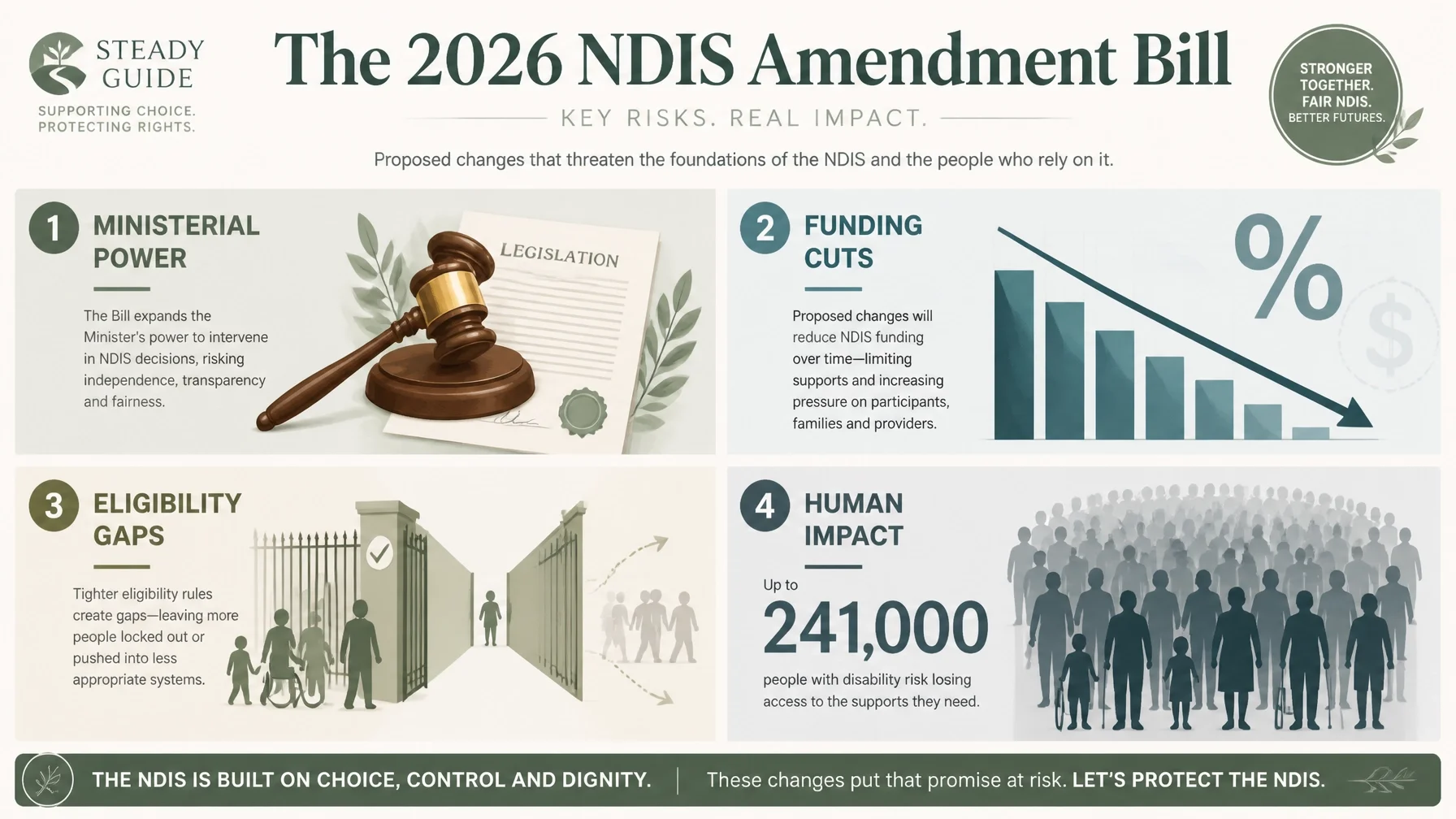
In plain English? It is trying to slow NDIS growth by tightening eligibility, tightening funding, and concentrating more decision-making power at the top.
That is the practical effect.
The official language sounds neat — “sustainability”, “future generations”, “clarity”, “integrity”. And again, I do think it is fair to acknowledge the stated purpose: to preserve the scheme for people with the most severe and lifelong support needs. That is not an unfair aim in itself.
The problem is what follows from that logic.
Because once the system is redesigned around protecting only the most obviously severe cases, a huge number of people who still need real support are left exposed. This Bill gives the Albanese Government stronger tools to decide:
who counts as eligible,
what counts as appropriate treatment and under what circumstances,
how much funding can be reduced,
and how much “choice and control” participants are actually allowed to keep.
That matters because this is where exclusion starts sounding administrative. Once these powers are written in, people are told the cuts are simply “how the system works now”.
Increased Ministerial powers to reduce funding
One of the most serious features of this Bill is the increased power handed to the Minister.
That might sound dry, but it has real consequences. The more power that sits in Ministerial rules, the further participants are pushed from the decisions that shape their daily lives. Instead of support being driven by lived need, it becomes easier for governments to redraw the boundaries from above.
And yes — that includes the power to reduce funding.
The intent here is hard to ignore. The Bill creates room for support categories to be cut by ‘a percentage (lower than 100%)’. Even if we weren’t talking about a possible reduction up to 99.9%, a support does not have to be abolished outright to become useless. It only has to be reduced enough that people can no longer rely on it or that it becomes ineffective.
That is the danger of this approach. A service might still exist on paper but in practice, it does not benefit anyone.
For participants, this could mean:
having to choose between getting the groceries done or attending a medical appointment,
decreased ability of allied health professionals to assist participants to gain independence,
less flexibility when the unexpected comes up.
If the Government’s goal is sustainability, then it needs to answer a basic moral question: sustainable for whom? Because support that is technically preserved but practically hollowed out is not real security. It is managed scarcity with better branding.
Choice and control keeps getting watered down
Let’s be honest — choice and control has been under pressure for years. This Bill doesn’t reverse that. It keeps grinding it down.
The public language still talks about participant-centred support. But the legal direction is increasingly about approved categories, tighter definitions, and decisions being made further away from the person actually living with disability.
In plain English: you may still be told you have “choice”, but only inside a smaller box.
That matters because real life is messy. Disability doesn’t fit neatly into government categories. A support that is vital for one person may not look textbook enough for a decision-maker sitting behind a desk. When the system narrows, participants are forced to justify themselves over and over again — often in the middle of burnout, crisis, grief, or trauma.
That is especially dangerous for people whose support needs fluctuate, or whose disability has always been misunderstood by rigid systems.
Redefining “permanence” and “appropriate treatment”
This is one of the most dangerous parts of the Bill.
The scheme has always relied heavily on ideas like permanence and evidence of disability. The clarifications made around permanence merely state what NDIA planners have been saying for quite some time. This Bill raises serious concerns about how “permanence” and “appropriate treatment” can be interpreted and tightened to limit eligibility.
And once those terms start shifting, people get hurt.
If the Government narrows what counts as “permanent”, then more people can be told:
your condition might improve,
you haven’t tried enough treatment,
your impairment is not settled enough,
or your support needs should be managed somewhere else.
That doesn’t just affect new applicants. It creates a pathway for current participants to have access questioned, restricted, or revoked.
If you live with a disability that is lifelong but variable, poorly understood, or treated with scepticism, these changes are not theoretical. They are personal. You may be forced to keep proving your reality to a system that keeps moving the goalposts.
And that is where “appropriate treatment” becomes especially dangerous. Who decides what is appropriate? A specialist who understands your actual life? Or a financially-stricken system looking for reasons to say you haven’t ticked enough boxes yet?
When governments start using treatment as a gatekeeping tool, the risk is obvious: support gets denied not because people don’t need it, but because the system decides they can't afford your disability.
Why participants with psychosocial disability should be especially concerned
If you have psychosocial disability, you already know how often the system confuses fluctuating with insignificant.
That confusion causes harm.
Psychosocial disability doesn’t stop being real because support needs vary across time or across environments. It doesn’t stop being disabling because someone has a good week, or masks well in an assessment, or has tried every therapy under the sun and is still struggling to stay afloat. But systems built around rigid proof start to merge into medical models of disability.
This Bill creates more room for that kind of punishment.
When “permanence” is tightened and “appropriate treatment” becomes a bigger issue, people with psychosocial disability are at real risk of being told:
you should be treated in mainstream mental health instead,
you haven’t exhausted the right treatment options,
your condition is too episodic,
or your disability doesn’t fit the preferred model of permanence.
That is not a minor administrative issue. That is a direct threat to access.
And if you’ve ever had to fight to prove that your support needs are both real and enduring, you know how cruel that process can be.
People with mild or moderate disability are also in the firing line
This is the part that keeps gnawing at me: what happens to people who are not considered the “most severe”, but still plainly need help?
Because this Bill puts pressure on people with mild or moderate disability too.
Not because their needs are minor. Not because they are coping fine. But because systems trying to reduce growth almost always start sorting people into categories of who is “disabled enough” to deserve funding.
If your disability is seen as less severe, more manageable, or more likely to be redirected into generic community supports, you may lose access in the name of “sustainability”. That is the pivot we need to watch carefully. The language sounds responsible. The human outcome can be brutal.
The message becomes: you might still need support, but not this support, not here, not at this level.
That leaves people stranded in the gap between systems:
too disabled to manage without support,
not considered disabled enough for secure NDIS access,
and pushed toward underfunded mainstream or foundational services that may not exist in any meaningful way.
And that is the question the Government still has not answered properly: where will support come from for the people left outside the tighter definition?
That gap is where people burn out. That gap is where carers collapse. That gap is where independence gets praised while real help is quietly withdrawn.
The modelling is the warning sign we should not ignore
Unfortunately, this is not just administrative tidying.
The expectation associated with this policy direction is that 241,000 participants could lose access by 2031.
That number should stop everyone in their tracks.
Because behind every “participant reduction” figure is a person. A teenager who finally got support. An adult with psychosocial disability who can live independently because they have help. A family who can function because respite exists. A person with mild or moderate disability who can work, study, parent, or simply survive because the right support is in place.
And this is why the language of “future generations” needs to be handled carefully. A future is not being secured if today’s participants are being squeezed out, redefined out, or cut out.
What you can do now
I don’t believe in panic. But I also don’t believe in staying quiet and hoping someone else will fix this.
What I do believe in is getting organised — and getting loud.
If this Bill is making you nervous, practical steps matter:
Get your evidence in order. Make sure reports clearly describe functional impact, permanence, and why supports are needed in daily life.
Do not assume current access is untouchable. If your eligibility could be questioned under tighter definitions, prepare now.
Watch for red flags in planner language. Terms like “appropriate treatment”, “foundational supports”, and “better suited elsewhere” can be signs that your access is being narrowed.
Track funding changes closely. If support categories are reduced, even partially, the impact on your real life budget can be severe.
Get proper support. A good support coordinator should help you understand the rules, not drown you in them.
Band together and speak up. Write a submission to the Senate inquiry. I know how difficult that is. Do it within a peer group, a carer group or with a trusted friend. Encourage your family, your providers, your allies, and your community to do the same.
Demand not to be forgotten. If you live with psychosocial disability, mild disability, moderate disability, fluctuating support needs, or the kind of complexity bureaucrats love to minimise, your voice matters here.
This is not the moment for polite silence. If the scheme is being reshaped around who is “severe enough”, then the community needs to push back hard on the idea that everyone else will simply disappear into thin air.
Write. Speak. Share your story. The submission deadline passed on 10 July. But that does not mean we should be quiet. Share your story with your member of parliament. Write to media outlets about why this amendment could see thousands unsupported.
If you’re local, this is also why having someone grounded in your actual community matters. Not a giant provider where you become a NDIS number. A real person who can sit with you, go through the paperwork, and tell you honestly what the risks are.
Why local, low-caseload support matters even more now
In a system moving toward tighter rules and less flexibility, you cannot afford to be just another name on a national provider’s spreadsheet. That is how coordinators miss letters, miss deadlines, miss evidence requests — and participants end up in avoidable trouble.
That is one reason I started Steady Guide.
I live in Toowoomba. I keep my caseload capped at 20 participants because I want enough time to do this properly. When something this serious is happening, you deserve more than vague reassurance. You deserve someone who can read the fine print, explain what it means in plain English, and help you prepare before the damage is done.
You deserve to sit down in a sensory-friendly office, have a cup of tea, and talk it through with someone who won’t minimise what’s at stake.

I bring a background in psychology, writing, and business — but more than that, I bring lived experience as a carer and years inside the NDIS world. I know the rage that comes with being dismissed. I know the exhaustion that hits when every form feels like another test you didn’t ask to sit.
My work is not about doing paperwork at you. It is about helping you understand the system, protect your position, and build the confidence to advocate for yourself in a scheme that keeps getting harder to trust.
Don't try to carry this alone
If this Bill has rattled you, that makes sense. There is a lot at stake here. But you do not have to sort through it by yourself — and you should not feel like you have to stay quiet either.
If you want help understanding what these changes could mean for your situation, let’s talk in whatever way feels easiest and safest for you. And if you are ready to take action, now is the time to join with others, make noise, and tell decision-makers plainly that people with real support needs must not be abandoned because they don’t fit the narrowest definition of severity.
You can reach out by:
Booking a face-to-face chat: Come visit my sensory-friendly office in Toowoomba.
Text or call: I’m a real person, and I’ll speak to you like one.
Scheduling online: Use my booking link to find a time that works for you.
And beyond that — write a submission. Encourage others to write theirs. Ask hard questions. Demand better answers. Demand a future where people are not forgotten simply because their disability is not what the NDIS was originally intended for.
I won’t promise easy answers. But I will give you honest ones — and steady support while you work out your next step.