Why Hybrid Telehealth Models Build True Participant Capacity in Regional Thin Markets
By Jenny Mathers | Principal Support Coordinator, Author & Carer Advocate | Published September 2026
At a Glance & Quick Navigation
Central Message: Real capacity building requires human connection and localised scaffolding, not isolated video links.
- Purely digital platforms often fail to fill regional service gaps when used as a cheap replacement for local care.
- Hybrid models combine face-to-face local support with remote specialist knowledge to build long-term participant autonomy.
- Local health workers act as essential bridges, ensuring complex clinical care is delivered safely and effectively.
For families living across regional thin markets in Toowoomba, the Darling Downs, and the Western Downs, accessing specialised allied health supports often feels like an uphill battle. When local waitlists stretch across months, the system’s default answer is frequently a video conferencing link. But plugging a participant into a screen and expecting them to navigate complex therapy in isolation is not capacity building—it is administrative cost-cutting disguised as innovation.
When we look at findings from regional health roadshows [External Link – Opens in new window], the community’s message is loud and clear: digital tools must complement face-to-face care, never replace it. True self-determination grows when participants are supported to direct their care, learn new skills, and engage with specialists through a secure, blended model that respects their local environment.
1. Building Scaffolding Around Complex Care
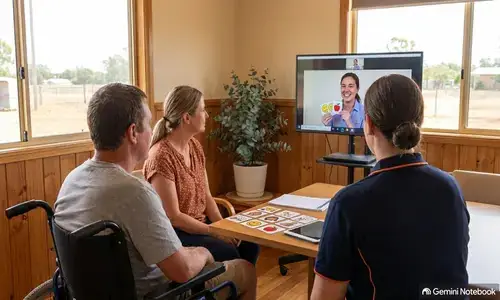
How do we support a participant to access complex, equipment-heavy therapies that do not translate well to a basic video call? The answer lies in local clinical scaffolding. In a hybrid care framework, a local therapy assistant, nurse, or community health worker physically joins the participant during the consultation. They handle specialised equipment, assist with physical positioning, and clarify technical instructions.
Over time, as participants become comfortable with the technology and format, their reliance on the local support worker naturally diminishes. This step-by-step transition builds genuine confidence and functional independence, turning an intimidating clinical procedure into an accessible routine.
💡 Jenny’s Practice Note: Hybrid telehealth is not about replacing human care; it is about surrounding regional participants with the local scaffolding they need to access top-tier clinical expertise without leaving their community.
2. Overcoming Digital Isolation in Thin Markets
In remote towns facing total digital blackouts or poor connectivity, relying solely on web portals creates immediate exclusion. By examining evaluation data on national outreach programs [External Link – Opens in new window], we see that telehealth works best as a complementary follow-up tool rather than a total replacement for face-to-face care, and that dedicated local coordination is required.
3. Summary Bibliography & Referenced Documents
Below are the primary research reports, clinical evaluation studies, and strategic frameworks referenced in this article:
- QAMH Regional, Rural and Remote Roadshow Report
Publisher / Source: Queensland Alliance for Mental Health | Type: Regional Health Report
Link: https://www.qamh.org.au [External Link – Opens in new window] - Tele-Diabetes Specialist Consultation Evaluation (PAH Telehealth Service)
Publisher / Source: World Health Organization (WHO) | Type: Clinical Evaluation Monograph
Link: http://apps.who.int [External Link – Opens in new window] - Evaluation of National Outreach Health Programs
Publisher / Source: Australian Department of Health / Rural and Remote Health | Type: National Evaluation Study
Link: https://doi.org/10.22605/rrh4544 [External Link – Opens in new window] - Steady Guide Regional Strategic Vectors & Thin Markets Framework
Publisher / Source: Steady Guide | Type: Regional Practice & Directory Framework
Link: https://steadyguide.com.au/provider-pulse/ [External Link – Opens in new window]
#SteadyGuide #HybridTelehealth #NDISWesternDowns #ThinMarkets #SupportCoordination #PeoplePotentialPossibilities