Thriving Kids NDIS: Minimising NDIS Transition Disruption for Queensland Families
Drafted by Penny, Google Notebooks Agent | Lead Blogging Specialist | Reviewed, Edited and Approved by Jenny Mathers, Principal Support Coordinator on 1 October 2026.
At a Glance & Quick Navigation
Central Takeaway: Queensland families can attempt to minimise transition angst by embedding functional supports in daily routines and partnering with local coordinators to maintain service continuity.
- Navigating Policy Uncertainty: While Queensland state negotiations and NDIS plan reviews create transition uncertainty, families can take proactive steps in an effort to safeguard their child’s therapy continuity.
- Focusing on Everyday Routines: Embedding skill-building into home, early childhood, and school environments protects developmental progress regardless of administrative funding shifts.
- Preparing Functional Evidence: Documenting your child’s functional support needs with current allied health providers strengthens your ability to advocate during NDIS plan reviews.
- Leveraging Parallel Community Supports: Utilising Medicare Healthy Kids Checks, MBS child development plans, and supported playgroups creates immediate local safety nets.
Addressing Transition Anxiety with Proactive Planning
Major disability policy overhauls naturally create anxiety for parents and carers. As the Commonwealth Government progresses the $4 billion Thriving Kids NDIS initiative, families across Queensland face ongoing policy debates between state and federal officials regarding bilateral funding terms and workforce readiness.
At the same time, regional families report that routine NDIS plan reviews are already creating uncertainty around individual therapy funding for children with mild to moderate autism or developmental delay. This was specifically highlighted by the State Minister for Families, Seniors and Disability Services in March. Read her speech. [External Link – Opens in a New Window] State representatives and provider peaks have raised valid concerns regarding provider viability and potential support gaps during transition periods.
While intergovernmental negotiations continue, we do not want parents to feel powerless. By shifting focus from administrative funding battles toward practical capacity building, families can establish resilient support structures with the aim of protecting their child from emotional angst and service disruption.
Step 1: Safeguarding Daily Routines and Environmental Supports
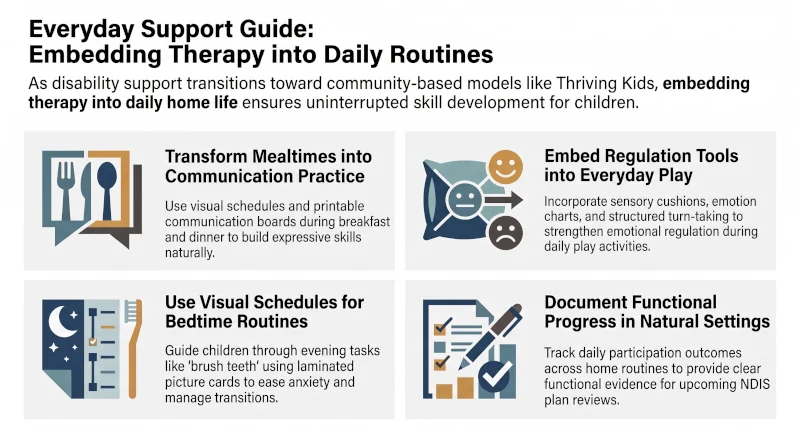
The most effective buffer against administrative uncertainty is building support directly into your child’s everyday environments. Early childhood intervention research emphasises that skill development occurs most naturally during daily activities such as mealtimes, play, and bedtime routines.
Continue embedding therapy strategies into daily family life, so that your child continues to learn. This might mean adapting communication tools, visual schedules, and sensory regulation strategies into everyday activities in the home. If you find your child’s therapy routine has been disrupted, embedding therapy into everyday life offers you and your child something to hold onto.
Partnering with early childhood educators and school teachers ensures these adjustments carry over into learning settings. By embedding supports into natural routines, your child receives consistent guidance even if formal clinical appointments experience temporary administrative delays.

Step 2: Preparing Comprehensive Functional Evidence for NDIS Plan Reviews
For families currently receiving NDIS funding, preparing for upcoming plan reviews is essential for maintaining therapy continuity. Recent ministerial statements indicate that children with low to moderate support needs face increased scrutiny during plan reassessments under the Thriving Kids NDIS framework.
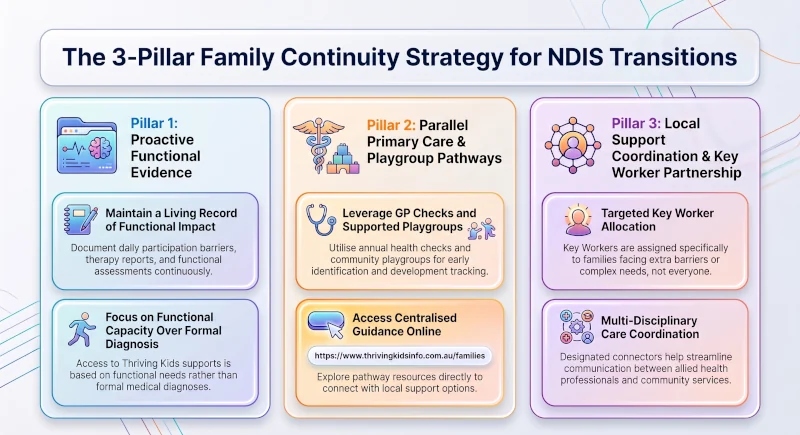
To minimise the risk of unexpected funding reductions, families should gather clear, functional evidence well before review meetings. Request that your current speech pathologist, occupational therapist, or physiotherapist complete a functional capacity evaluation.
These evaluations should explicitly document how specific therapies support your child’s participation in daily life, emotional regulation, and educational access. Demonstrating clear, goal-oriented functional outcomes provides strong evidence for maintaining necessary supports.
Step 3: Activating Parallel Community Supports and Primary Healthcare Pathways
Relying solely on a single funding mechanism can leave families vulnerable to system changes. Establishing parallel support pathways creates a vital safety net for your child.
Families can engage with primary healthcare initiatives, including the new Medicare Healthy Kids Check at age three and annual GP developmental assessments. Where appropriate, GPs can establish Medicare Benefit Schedule (MBS) child development plans to assist with initial allied health sessions.
Simultaneously, parents can access universal community programs, such as supported playgroups, peer support networks, and digital advice hubs. These soft-entry supports offer practical strategies and peer connection without waiting lists or formal eligibility hurdles. Families, GPs and allied health professionals can also find out more about Thriving Kids at the Thriving Kids Resource Hub [External Link – Opens in a New Window].
Step 4: Establishing a Key Worker Partnership for Those Families Facing Tough Barriers
When a child accesses supports across multiple health or education professionals, care coordination becomes crucial for reducing family stress. The Thriving Kids NDIS framework highlights the Key Worker model as best practice for early childhood intervention.
A Key Worker is a designated professional—such as an occupational therapist, speech pathologist, or specialist educator—who acts as a primary contact for your family. They coordinate care across transdisciplinary teams, provide direct coaching, and assist with service navigation.
Having a trusted Key Worker ensures that strategies remain aligned across home, early learning centres, and clinical settings. To examine national clinical standards for care coordination, health professionals and families can consult the National Best Practice Framework for Early Childhood Intervention [External Link – Opens in new window] for comprehensive guidance.
Step 5: Partnering with Regional Support Coordinators for System Navigation
Navigating evolving disability systems across regional Queensland requires knowledgeable, independent guidance. Families in Toowoomba, Darling Downs, and Western Downs face unique geographic and workforce challenges when seeking therapy access.
Local support coordinators assist families by mapping available community health hubs, Aboriginal Community Controlled Health Organisations (ACCHOs), and private allied health providers. Independent coordinators provide objective advice on transition pathways while maintaining strict separation from service commissioning.
Working with an experienced coordinator helps parents maintain clear long-term goals. By staying informed and prepared, families can navigate system changes calmly, ensuring their child receives steady, compassionate support.
Empowering Families as Confident System Advocates
Uncertainty during major policy shifts is understandable, but it does not have to compromise your child’s developmental trajectory. Building family capacity centers on equipping parents with self-advocacy skills, practical tools, and local support networks.
By focusing on daily environmental adaptations, gathering functional evidence, and engaging local coordinators, families create stability amidst change. Parents become empowered decision-makers who lead their child’s developmental journey with confidence.
Steady Guide remains committed to supporting regional Queensland families through publications such as the Provider Pulse, transparent policy analysis and dedicated support coordination. Together, we can ensure every child continues to learn, participate, and thrive in their community.
#SteadyGuide #ThrivingKidsNDIS #NDISToowoomba #WesternDownsAdvocacy #NDISReform #PeoplePotentialPossibilities
Topic-Specific Bibliography & References
- Australian Government Department of Health, Disability and Ageing. (2026). About Thriving Kids. Commonwealth of Australia. https://www.health.gov.au/our-work/thriving-kids/about-thriving-kids [External Link – Opens in new window]
- Australian Government Department of Health, Disability and Ageing. (2026). Engagement on Thriving Kids. Commonwealth of Australia. https://www.health.gov.au/our-work/thriving-kids/engagement-on-thriving-kids [External Link – Opens in new window]
- Australian Government Department of Health, Disability and Ageing. (2026). Supports we’re planning. Commonwealth of Australia. https://www.health.gov.au/our-work/thriving-kids/supports-were-planning [External Link – Opens in new window]
- Federal Financial Relations. (2026). National Agreement on Foundational Supports. Commonwealth of Australia. https://federalfinancialrelations.gov.au/agreements/national-agreement-foundational-supports [External Link – Opens in new window]
- Hon. Amanda Camm. (2026). Ministerial Statement on Disability Services. Record of Proceedings, Queensland Parliament. https://www.parliament.qld.gov.au/ [External Link – Opens in new window]
- The Guardian Australia. (2026). A new scheme is about to replace the NDIS for children with autism. Why has Queensland refused to sign up? https://www.theguardian.com/australia-news/2026/aug/23/ndis-reforms-autism-funding-thriving-kids-queensland [External Link – Opens in new window]
- Thriving Kids Advisory Group. (2025). Thriving Kids Advisory Group Final Report. Department of Health, Disability and Ageing. https://www.health.gov.au/committees-and-groups/thriving-kids-advisory-group [External Link – Opens in new window]
- Australian Psychological Society. (2026). Thriving Kids Inquiry final report released. https://psychology.org.au/insights/thriving-kids-inquiry-final-report-released [External Link – Opens in new window]