Thriving Kids NDIS: Minimising NDIS Transition Disruption Easy Read | Steady Guide

🔒 Zero spam. Unsubscribe at any time with one click.

4. Step 3: Use local community and doctor supports

Your family GP can help you access Medicare health checks and child development plans.

This gives your child Medicare-funded allied health sessions while you navigate NDIS plan changes.

Join local supported playgroups and community peer groups in Toowoomba and Western Downs.

These groups offer friendly advice and fun social play without waiting lists.

5. Step 4: Work with a Key Worker to link your care

A Key Worker is a trusted professional (like an OT or Speech Therapist) who leads your child’s team.

They guide your family, link goals across therapists, and stop you from feeling overwhelmed.
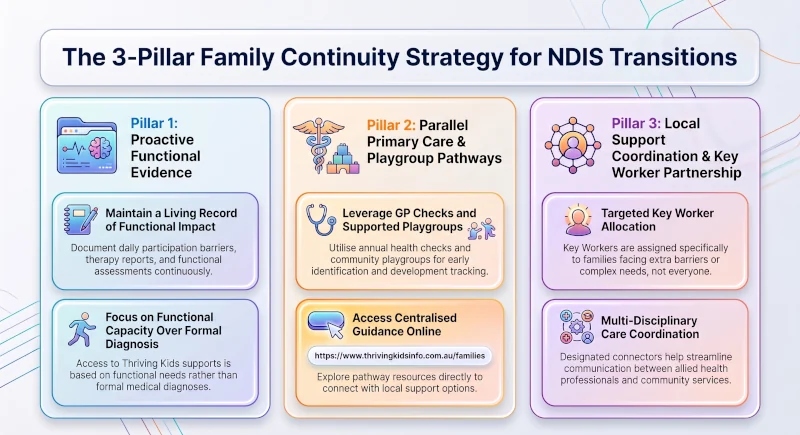
Bento-grid infographic illustrating 'The 3-Pillar Family Continuity Strategy for NDIS Transitions'. Panel 1: Proactive Functional Evidence; Panel 2: Parallel Medicare & Playgroup Pathways; Panel 3: Local Support Coordination & Key Worker Partnership.
Figure 2: The 3-Pillar Strategy: Getting reports ready, using community supports, and linking care with a Key Worker.
📍 Regional Navigation Assurance: Local support coordination provides independent advice across Toowoomba, Chinchilla, Miles, and Tara. We help you explore options so you stay in total control of your choices.

6. Step 5: Work with a local Support Coordinator

An independent Support Coordinator helps you understand complex NDIS rules.

At Steady Guide, Jenny Mathers caps her client list at 20 families so every child gets direct, expert care.

7. Words that are hard to understand (Glossary)

Thriving Kids: A new government framework that provides early intervention support for young children in Queensland.

Functional Capacity: A clear description of what a person can do independently in their everyday life.

Key Worker: A lead health professional who coordinates all therapy goals and acts as your primary contact.

Support Coordinator: A specialist helper who assists you in finding local services and managing your NDIS plan.

8. Topic-Specific Bibliography & References

  1. Australian Government Department of Health, Disability and Ageing. (2026). About Thriving Kids. Commonwealth of Australia. https://www.health.gov.au/our-work/thriving-kids/about-thriving-kids [External Link – Opens in new window]
  2. Australian Government Department of Health, Disability and Ageing. (2026). Engagement on Thriving Kids. Commonwealth of Australia. https://www.health.gov.au/our-work/thriving-kids/engagement-on-thriving-kids [External Link – Opens in new window]
  3. Thriving Kids Advisory Group. (2025). Thriving Kids Advisory Group Final Report. Department of Health, Disability and Ageing. https://www.health.gov.au/committees-and-groups/thriving-kids-advisory-group [External Link – Opens in new window]
  4. Australian Psychological Society. (2026). Thriving Kids Inquiry final report released. https://psychology.org.au/insights/thriving-kids-inquiry-final-report-released [External Link – Opens in new window]

1 thought on “Easy Read Minimising NDIS Transition Disruption”

Comments are closed.