NDIS Section 100 Checklist: A Regional Carer Guide to Internal Reviews
Drafted by Penny, Google Notebooks Agent | Lead Blogging Specialist | Reviewed, Edited and Approved by Jenny Mathers, Principal Support Coordinator on 25 September 2026.
💡 At a Glance
⏱ Estimated Read Time: 7 minutes
Central Takeaway: Mastering procedural timeframes and Section 9B evidence framing transforms an internal review from a repetitive request into a vehicle of self-advocacy.
- Section 100 of the NDIS Act is the formal legal mechanism to request an internal review of a reviewable decision.
- Requests must be lodged within a strict statutory window of 3 months from receiving notice of the decision.
- Clinical evidence must be informed and grounded in Section 9B rules to assess functional capacity in a sterilised context excluding environmental variables.
- If the NDIA fails to make a decision within 90 days, it becomes a Deemed Refusal, allowing a direct appeal to the Administrative Review Tribunal (ART).
💡 Jenny’s Support Tip: You do not need complex jargon to defend your rights. Filing an oral request immediately locks in your lodgement date while you gather your clinical reports. Always follow up with a written request to be added to the S.100 case request.
1. Understanding Section 100 and Reviewable Decisions Under Section 99
Section 100 of the National Disability Insurance Scheme Act 2013 serves as the primary legal mechanism for merits-based reconsideration. It acts as a formal procedural gatekeeper that holds the National Disability Insurance Agency accountable. Rather than submitting a simple “second look,” advocates view Section 100 as a structured legal necessity.
Before requesting an internal review, you must verify that the Agency’s action is classified as a “Reviewable Decision” under Section 99 [Opens in a New Window]. Reviewable decisions include access rejections, plan support approvals, and determinations regarding high support needs status.
| Decision Type | Section 99 Status | Corresponding Provision |
|---|---|---|
| Access Requests | Reviewable | s.24 / s.25 |
| Plan Approvals (Supports) | Reviewable | s.33(2) |
| High Support Needs Status | Reviewable | s.47B(4)(a) |
| Plan Variation Decision | Reviewable | 47B(5)(a)(i) |
| Ministerial Funding Cuts | Challenged via s.47B | s.34A / s.47B |
| Automatic Successor Plans | NOT Reviewable | s.50A(4)(b) |
Requests for review may be filed by the affected person, their plan nominee, or an authorised representative under Section 74 for children. Ensure that representatives maintain explicit, documented consent to prevent procedural delays by the Agency.
2. Navigating the Section 9B Functional Capacity and I-CAN Pivot
Section 9B acts as a substantive evaluation tool during an internal review. Legislation covering access decisions, plan reassessment and variations, and reasonable and necessary support determinations now contain notes pointing to Section 9B. Under this framework, reviewers assess a participant’s capacity based on the “activity as a whole” within a “sterilised context”. Read Section 9B [Opens in a New Window]
Unlike historical barrier-based models, Section 9B(1)(b) explicitly requires reviewers to exclude environmental and personal circumstances. Clinical evidence must focus strictly on innate physiological and functional impairments.
For child participants, Section 9B(1)(a)(ii) provides a critical exception: functional capacity includes assistance from others if that assistance is “appropriate to the person’s age”.
For example, if a child can attend soccer practice when their parent transports them to the field, then legally the child is treated as having the capacity to attend soccer practice.
This exception forms the primary legal defense against improper “parental responsibility” support declines.
📊 Comparative Analysis: Section 9B Evidence Framing
“Harry manages showering safely when their support worker sets up adaptive handles and monitors fatigue.”
Risk: NDIA reviewers may interpret this as functional independence due to informal/environmental setup.
“In an unassisted environment, Harry experiences severe postural instability and loss of motor control during personal hygiene activities, resulting in high fall risk.”
Outcome: Establishes innate physiological deficit under Section 9B rules.
At this point, we need to stop and think about the type of evidence we need to submit.
Section 9B is heavily aligned with the medical model of disability; but Section 34, Reasonable and Necessary Supports is heavily aligned with the social model of disability.
Herein lies a valuable opportunity.
When a participant’s functional capacity is described in such a way, it satisfies the legal requirement and gives the reviewer a baseline of the participant’s functional capacity, but it does not give a picture of the participant’s real world functional capacity. Using I-CAN statements directly from the I-CAN report, of which you should have received a copy, alongside these S.9B functional capacity descriptions, can be applied to real world applications of what is actually reasonable and necessary in the real world.
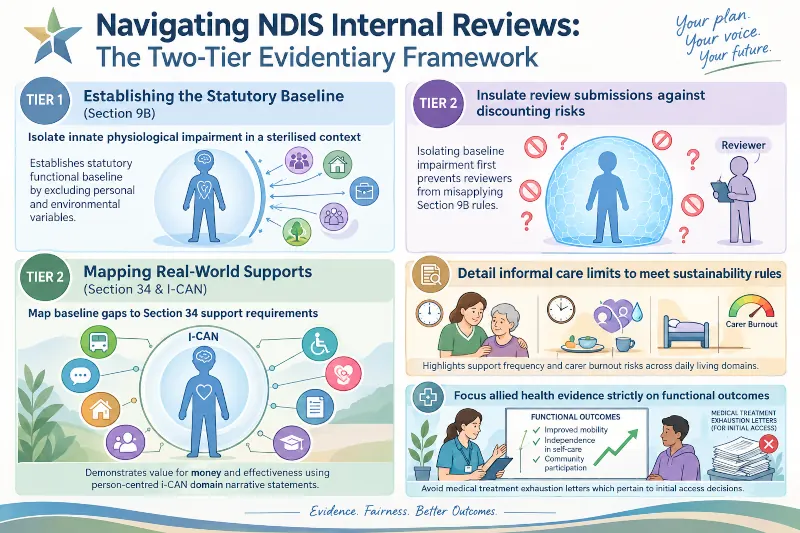
Navigating NDIS Internal Reviews: The Two-Tier Evidentiary Framework
📖 Read the full plain-text breakdown of this framework
Framework Overview: The Two-Tier Evidentiary Framework is designed to protect regional NDIS participants against unfair plan reductions during internal review (Section 100) requests:
- Tier 1 — Statutory Baseline (Section 9B): Isolates the participant’s innate physiological or cognitive impairment to establish a permanent statutory baseline under Section 9B of the NDIS Act.
- Tier 2 — Reasonable & Necessary Support Mapping (Section 34): Insulates the submission against NDIA evidence discounting by mapping supports directly against Section 34 criteria and person-centred I-CAN domain statements.
- Informal Care Boundaries & Burnout Mitigation: Explicitly documents informal support capacity limits, family carer fatigue, and sustainable care boundaries under NDIS Operational Guidelines.
- Functional Outcome Alignment: Strictly aligns allied health clinical reports (OT, Speech, Physio) with tangible daily functional goals across home, community, and regional settings.
E.g. Without human assistance or a shower commode, I would have to sit/lie on the shower floor to wash and would only be able to wash the parts of my body I could reach (S. 9B statement of functional capacity). The NDIA’s own I-CAN assessment established that I can participate in my daily showering routine when provided with a mobile shower commode and the direct physical assistance and supervision of one disability support worker. My worker assists me to transfer onto and off the commode, safely manoeuvres my commode within the shower recess and washes my lower back, hair, and lower extremities. My worker must also provide continuous verbal prompting for task sequence and execute post-shower transfers and skin drying to maintain personal safety and skin integrity.
As an aside, it is truly difficult to write these kinds of S.9B statements about participants, as it presents people in an undignified manner.
However, by coupling these two together, you are attempting to prevent the reviewer from misapplying Section 9B rules to reject Section 34 funding and directly address how a support represents value for money, whether it is likely to be effective and beneficial, and the limits of informal care.
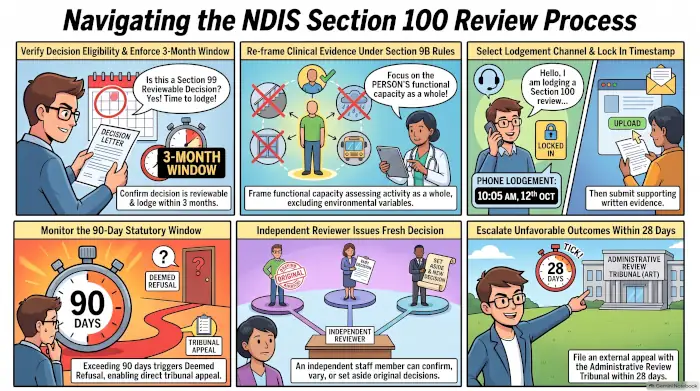
3. The 7-Step Section 100 Lodgement Protocol
Executing an internal review requires strict procedural precision to protect your legal standing. Follow these seven steps when lodging a Section 100 request:
Step 1: Jurisdictional Verification (s.99) — Confirm the decision is reviewable under Section 99. Remember that automated Section 50A plan rollovers cannot be reviewed directly; you must review the underlying original plan decision.
Step 2: Procurement of Reasons (s.100(1)) — Request the formal written notice of the reviewable decision from the Agency. Identifying the exact evidentiary gaps allows clinicians to write targeted reports.
Step 3: Statutory Window Enforcement (s.100(2)) — Lodge your request within 3 months of receiving the decision notice. This represents a hard statutory deadline.
Step 4: Evidentiary Synthesis (The s.9B and I-CAN Pivot) — Re-frame all Allied Health evidence to reflect both the innate capacity in a sterilised environment, as well as the I-CAN report that includes environmental variables.
Step 5: Selection of Lodgement Channel (s.100(3)) — Utilise oral lodgement over the phone for immediate timestamping, then submit written documentation to lock in your evidence.
Step 6: Receipt and Record Keeping (s.100(4)) — Ensure the Agency records the request in writing and obtain a reference number immediately to track the statutory timeframe.
Step 7: Monitoring Statutory Timeframes (s.100(6A)) — Distinguish between the 60-day operational target and the 90-day statutory limit. A failure to make a S.100 decision within 90 days triggers a Deemed Refusal.
4. Deemed Decisions, Urgent Triggers, and Automatic Expansion
Special statutory chains manage Ministerial funding cuts and high support needs cases. Under Section 34A and Section 47B, if a participant requests a variation and the CEO fails to act within 21 days, a decision is taken to have been made not to vary the plan.
This 21-day administrative failure triggers an automatic Section 100(5) internal review. Advocates monitor this window closely for participants requiring continuous 24-hour care.
For participants experiencing acute crisis or hospital discharge, urgent review acceleration requires Agency contact within 48 hours. Furthermore, under Section 101(2), if a plan is varied or replaced while an internal review is pending, the review automatically expands to cover the new decision.
5. Reviewer Authority, Sustainability Rules, and Statutory Outcomes
An internal reviewer performs a de novo review, making a fresh assessment based on all evidence current at the time of review. Under Section 100(6), the reviewer may confirm, vary, or set aside and substitute the original decision.
6. Plain English Jargon Translation Table
| NDIS / Legal Term | Plain English Translation |
|---|---|
| Section 100 | A formal request asking the NDIS to re-examine a decision. |
| Section 9B | Rules regarding how daily functional capacity is evaluated. |
| Deemed Refusal | An automatic refusal created when the NDIS misses its deadline. |
| De Novo Review | A completely fresh assessment using all updated evidence. |
| Section 103A | A law ensuring your review continues even if your plan rolls over. |
7. Frequently Asked Questions
How long do I have to lodge a Section 100 review request?
You must lodge your Section 100 review request within 3 months from the date you receive written notification of the original decision.
What happens if the NDIS does not make a decision within 90 days?
If 90 days pass without an internal review decision, it is legally treated as a Deemed Refusal under Section 100(6A), granting you the right to appeal directly to the Administrative Review Tribunal (ART).
Can I request an internal review if my plan automatically rolled over?
Automated successor plan rollovers under Section 50A are not reviewable decisions, but Section 103A guarantees that an ongoing review of your original plan continues seamlessly across successive plans or rollovers.
8. Escalation Pathways and Next Steps
If a Section 100 outcome remains unfavorable, or if a Deemed Refusal occurs at the 90-day mark, you have the right to lodge an external review appeal with the Administrative Review Tribunal (ART) under Section 103 within 28 days.
At Steady Guide, Principal Support Coordinator Jenny Mathers maintains a strict active caseload cap of 20 clients to ensure direct, expert-led advocacy for regional families across Toowoomba and the Western Downs.
9. Bibliography & Legal References
Below is the formal reference library supporting this Section 100 Internal Review guide, spanning NDIS legislation, statutory amendments, NDIA operational guidelines, Freedom of Information releases, and practice manuals:
- National Disability Insurance Scheme Act 2013
Primary Legislation / Statutory Framework
Online Location: Federal Register of Legislation [External Link – Opens in new window] - NDIS Amendment (Securing the NDIS for Future Generations) Bill / Act 2026
Statutory Reform Package & Regulatory Guidance
Online Locations:- Parliamentary Text: Australian Parliament House (APH) [External Link – Opens in new window]
- Departmental Policy: Department of Health, Disability and Ageing (DHDA) [External Link – Opens in new window]
- Commission Guidance: NDIS Quality and Safeguards Commission [External Link – Opens in new window]
- NDIA Operational Guideline: Reviewing Our Decisions
Official Operational Guidance
Online Location: NDIS Our Guidelines Portal [External Link – Opens in new window] - NDIA FOI Document Release FOI 25/26-0816 (Therapy Supports & Operational Guidance)
Freedom of Information Disclosure
Online Location: NDIA Freedom of Information Disclosure Log [External Link – Opens in new window] - NDIA Freedom of Information (FOI) Processing Manual
Administrative Processing Manual
Online Location: National Disability Insurance Scheme Website [External Link – Opens in new window]