Why Hybrid Telehealth Models Build True Participant Capacity – Easy Read Guide
Written by Jenny Mathers | Principal Support Coordinator and Carer Advocate
What is in this guide
1. Building support around complex care
Sometimes local therapists are hard to find in regional towns.
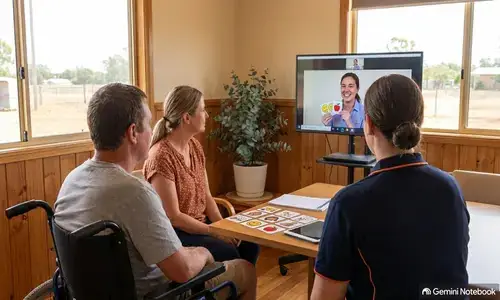
Telehealth lets you talk to expert therapists on a computer screen without travelling long distances.
A local worker stays in the room to help you.
They help with therapy tools, physical positioning, and technology so you feel safe and supported during video calls.
As you build confidence, you will need less help.
Learning to use telehealth step-by-step builds your independence and gives you more choice over your care.
🌱 Jenny’s Practice Note: Hybrid telehealth is not about replacing human care. It surrounds you with local support so you can see distant specialists without leaving your home town.
2. Helping regional towns connect online
Some regional towns have poor internet or mobile reception.
We use local community hubs, libraries, and offline workflows so you are never left out because of bad reception.
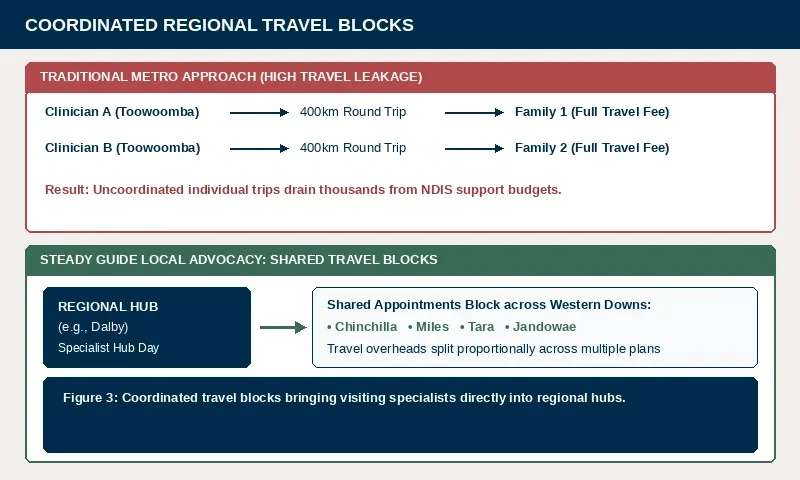
Coordinated travel blocks bring visiting therapists to you.
We help visiting therapists see several local families on the same day. This splits travel costs and saves your NDIS funding.
3. Read the scientific research
This guide is backed by medical research and government studies.
👉 Read all research references in our Standard Article Bibliography.
Subscribe to the Steady Steps Newsletter
Join local Toowoomba and Western Downs families receiving plain-English NDIS updates, local Allied Health capacity insights, and our instant free 7-Step Section 100 Review Checklist.
4. Words that are hard to understand
- Telehealth:
- Seeing a doctor or therapist on a video call using a computer, tablet, or smartphone.
- Hybrid Model:
- Combining video calls with in-person help from a trained local worker in the room.
- Thin Market:
- A regional town or remote area where there are not many local therapists or support services available.
- Scaffolding:
- Extra help and support built around you until you feel confident to do things on your own.
- Travel Blocks:
- Booking several appointments in the same town on the same day so therapist travel costs are shared.
#SteadyGuide #HybridTelehealth #NDISWesternDowns #ThinMarkets #EasyRead
1 thought on “Why Hybrid Telehealth Models Build Real Participant Capacity Easy Read”
Comments are closed.