NDIS Section 100 Checklist: A Regional Carer Guide to Internal Reviews (Easy Read Edition)
Drafted by Penny, Google Notebooks Agent | Lead Blogging Specialist | Reviewed, Edited and Approved by Jenny Mathers, Principal Support Coordinator on 25 September 2026.
💡 At a Glance
⏱ Estimated Read Time: 4 minutes
Central Takeaway: This Easy Read guide explains how to ask the NDIS for an internal review (Section 100) if you disagree with a funding decision, using simple words and clear picture cards.
Let us start by explaining how an NDIS internal review works.
What is a Section 100 Review?
A Legal Right
Section 100 is an important rule inside the official national NDIS legislation. This law gives participants and carers the legal right to challenge any funding decision.
Fresh Decision Process
The NDIS will perform a completely fresh review of your whole support plan. A new decision maker reviews all submitted evidence as if starting from scratch.
Support for Carers
Disability participants and family carers can submit this official review request together easily. You can ask for more funding when your current plan lacks necessary supports.
Navigating NDIS Internal Reviews: The Two-Tier Evidentiary Framework
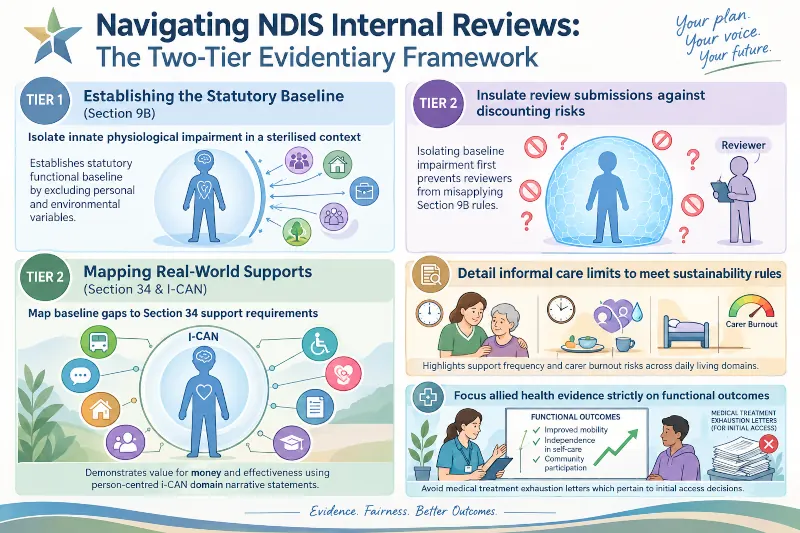
Follow these seven simple steps to lodge your formal NDIS review request successfully.
7 Easy Steps to Ask for a Review
Step 1: Check the decision can be reviewed.
Access decisions, plan variations, plan approvals, high needs support status decisions can all be reviewed. Ministerial funding cuts can be challenged, but not directly reviewed.
Step 2: Find out why they built your plan the way they did.
List every item that was not funded in your plan and then find out why. Explain clearly why the original funding decision is wrong for your daily life.
Step 3: Lodge your request within three months.
It is always best to ring the NDIA on 1800 800 110 to tell them that you are requesting that someone else needs to review the decisions made in your plan. You can follow up with a written request later. Ask a trusted person or your support coordinator to help you fill it out if you need it.
Step 4: Ask your therapists to help.
Ask your therapists to describe your ability to do things in every day life in two ways. They need to describe your ability to do everyday things without help and assistive technology, and then describe your ability to do things with assistance and assistive technology. This will help the reviewer to understand your real needs.
Step 5: Send Form and Evidence
Send your completed application form and all new clinical reports to the NDIA. Always keep a full personal copy of every document for your records.
Step 6: Track Your Deadline
Count ninety days forward from the exact date you submitted your review form. Write this important final decision date clearly on your home or mobile calendar.
Step 7: Get Expert Support
Ask your Support Coordinator or independent disability advocate to help you with your application. Ask them to remind you when the deadline has passed, so that you can request a new review to be done by the Administrative Review Tribunal.
Read below to learn how Steady Guide supports regional Queensland families with NDIS reviews.
How We Help You at Steady Guide
Professional Rigour
Founder Jenny Mathers holds a Psychology degree and has worked in the industry for the past five years. She also brings over forty years of personal lived carer experience to advocacy.
Capped Caseloads
Jenny strictly limits her total participant caseload to just twenty regional families. This commitment guarantees you direct responsive expert support without ever becoming a spreadsheet item.
People First
We always place human connections before bureaucratic rules and confusing paperwork systems. Our team respects your individual voice and values your unique lived family experiences.
Potential Focus
We focus relentlessly on your personal strengths and daily capacity building goals. Our guidance helps you build real skills rather than defining you by barriers.
Possibilities
We build creative local support solutions within regional thin markets across Queensland. Our team proudly advocates for families living across Toowoomba and the Western Downs.
Legal References & Bibliography 📚
Grounded in Official NDIS Law & Guidelines
This guide is built on the NDIS Act 2013, NDIS Practice Standards, and official administrative review rules.
Check the helpful word list below to understand tricky legal and NDIS terms.
Words That Are Hard to Understand (Glossary)
⚖️ Section 100: The specific rule in NDIS law that allows you to request internal reviews.
📋 Section 9B: The official legal rule in NDIS law that defines who becomes a participant.
⏱️ Deemed Refusal: When the NDIA takes over ninety days, the law automatically counts it as no.
🆕 De Novo Review: A fresh review where a new decision maker evaluates all evidence from scratch.
🏛️ Administrative Review Tribunal (ART): An independent tribunal that reviews NDIS decisions if you disagree with internal reviews.
1 thought on “Easy Read NDIS Section 100 Checklist”
Comments are closed.