Demystifying NDIS Jargon: Reasonable and Necessary Supports Guide
Drafted by Penny, Google Notebooks Agent | Lead Blogging Specialist | Reviewed, Edited and Approved by Jenny Mathers, Principal Support Coordinator on 26 September 2026.
At a Glance
⏱️ Estimated Read Time: 11 minutes
Central Takeaway: Translating administrative and legal NDIS jargon into plain English reduces cognitive fatigue, builds participant capacity, and empowers regional Queensland families to navigate plan reviews with confidence.
- Translating Bureaucracy: Plain English cuts through hard legal codes like PACE, Section 100, and Section 9B to protect your rights.
- Reasonable & Necessary Rules: All funded supports must satisfy Section 34 statutory criteria and scheme sustainability requirements.
- Evidentiary Hierarchy: Section 34(1E)–(1F) prioritises peer-reviewed research and clinical reports to prove functional outcomes.
- Local Regional Support: Steady Guide delivers 1:1 support coordination across Toowoomba, Chinchilla, Miles, and Tara with a capped 20-participant caseload.
1. Translating Administrative & Legal Terms
Navigating the National Disability Insurance Scheme (NDIS) often feels like learning an entirely new language. Complex legal codes, statutory acronyms, and bureaucratic definitions can create overwhelming cognitive fatigue for participants and carers who live in regional and remote regions across Toowoomba, Chinchilla, Miles, and Tara. When you are already managing daily care, decoding government legalese should not stand between your family and essential supports.
At Steady Guide, we believe that clear communication is an act of respect. Translating bureaucratic jargon into plain English is essential to reducing administrative stress and building participant capacity. When families understand the exact mechanics of the system, they can make informed decisions and advocate effectively for their rights.
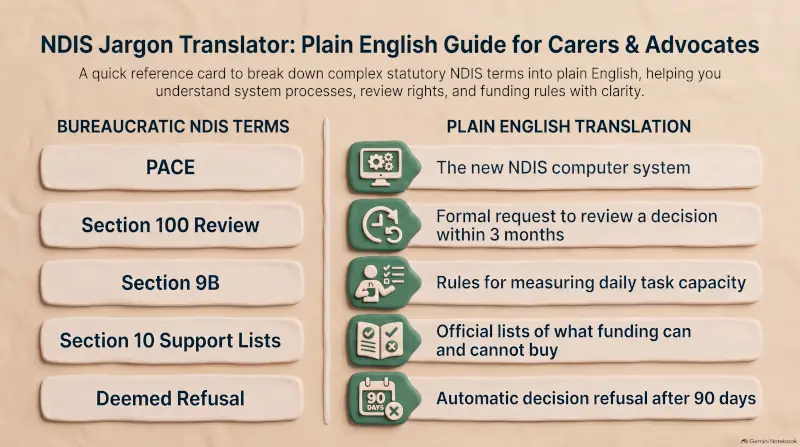
Demystifying NDIS Terminology: Comparative Reference Guide
📖 Click to read full plain-text breakdown of these NDIS terms
Plain English Term Translation Matrix:
- PACE: The new NDIS computer system used by the NDIA to manage plans, providers, and funding.
- Section 100 Review: Formal request to review an NDIA decision within 3 months.
- Section 9B: Rules for measuring daily task capacity and functional impairment, which planners apply to access requests and support requests in different ways.
- Section 10 Support Lists: Official lists of what NDIS funding can and cannot buy.
- Deemed Refusal: Automatic decision refusal after 90 days of NDIA inactivity on a review request.
The agency’s shift to PACE, which represents the new NDIS computer system, changes how plans are built and managed. Understanding these system updates helps regional families avoid unexpected payment delays. Similarly, if you disagree with a funding decision, Section 100 allows you to submit a formal request to review an NDIA decision within a 3-month statutory window.
When submitting clinical evidence, planners evaluate Section 9B rules to measure your daily functional capacity in a standardised environment. These rules are evaluated against the different parts of the legislation that cover access requests and support requests. Knowing these legal definitions ensures your allied health reports highlight real-world barriers rather than abstract scores. If the agency fails to make a decision on your review within 90 days, a Deemed Refusal occurs automatically under Section 100(6A), opening a direct pathway to appeal to the Administrative Review Tribunal (ART).
More plain English and easy read explanations can be found at our Easy Read Hub [Opens In a New Window] and What Does That Mean pages [Opens In a New Window]
💡 Visual Comfort Stop: Clear info builds confidence. When hard words are gone, families can make good choices about daily support.
2. Reasonable and Necessary Deep Dive & Scheme Sustainability
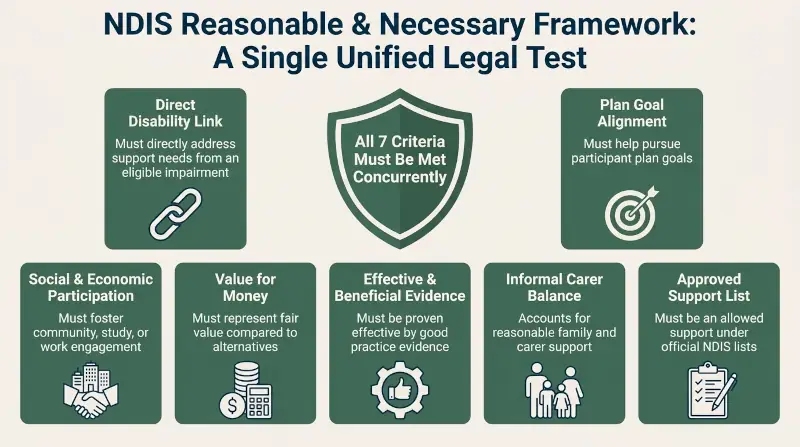
Every funding decision in an NDIS plan centers on whether a requested support meets the criteria for Reasonable and Necessary Supports.
In everyday language, this means a planner can only approve a support when it satisfies all of the criteria in the legislation.
- Whether it is directly related to the covered disability
- whether it aligns with your plan goals
- whether it will help you join in with your community
- whether there are other supports that could do the same thing but cost less money (value-for-money)
- whether there is evidence the support is likely to be effective and beneficial
- whether it is reasonable for family and/or other community supports to provide the support instead
- whether it is an NDIS support for you.
All of these questions must be answered favourably for the requested support to be funded. For example, funding a standard manual or power wheelchair is reasonable and necessary, whereas requesting a diamond-studded wheelchair frame is not (because it would not meet the criteria for value for money). Read the part of the legislation that defines what reasonable and necessary means [Opens in a New Window]. But be sure to read Schedule 1, Part 6 of the updated Amendment as well (particularly item 73) [Opens in a New Window].
Under recent legislative updates, planners evaluate reasonable and necessary requests through the lens of overall scheme sustainability. Parliament has introduced structural budget controls, which they have said they have introduced to ensure the NDIS remains financially viable for future generations. This includes establishing a statutory 8% annual growth framework and tightening evidence requirements for capacity building and daily living budgets.
For regional Queensland families, scheme sustainability does not mean accepting inadequate care. Instead, it means that every funding request must be backed by clear, objective evidence showing how the support helps you achieve functional independence and reduces long-term reliance on formal paid supports.
3. The Section 34 Evidentiary Hierarchy
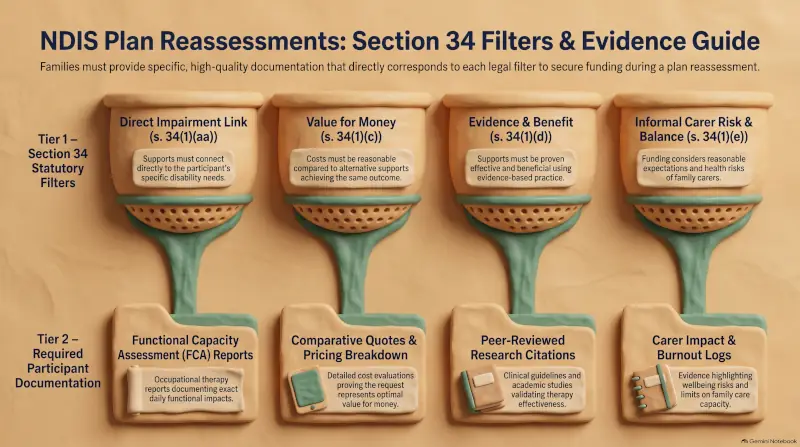
To satisfy the tightened Section 34 sustainability tests, participants and advocates need to gather evidence that directly addresses four key statutory filters:
First, under Section 34(1)(aa), you must prove a direct link. Clinical reports or Functional Capacity Assessments (FCAs) from qualified allied health professionals must demonstrate how the requested item directly addresses your support needs caused by your primary impairment that has met the NDIA access requirements.
Second, under Section 34(1A)–(1D), planners must enforce strict value-for-money rules. You must provide comparative quotes showing the requested item is competitively priced against lower-cost market alternatives. For equipment or home modifications, planners consider on a case-by-case basis whether leasing represents better value for money if your circumstances are likely to change in the short term.
SECTION 34(1E) STATUTORY EVIDENCE HIERARCHY
- PEER-REVIEWED RESEARCH: Published, generalisable clinical studies.
- INDIVIDUAL CLINICAL EVIDENCE: Practitioner reports for specific profile.*
- HISTORICAL OUTCOME TRACKING: Progress tracking demonstrating functional gain.
*OVERRIDING RULE S.34(1F): A planner may reject items lacking peer-reviewed research, even if individual clinical reports are provided.
Third, under Section 34(1E)–(1F), planners evaluate whether a support is “effective and beneficial” using a strict, prioritised evidence hierarchy. Published peer-reviewed research holds top priority, followed by individual clinical reports and historical outcome tracking. Crucially, Section 34(1F) empowers planners to reject a requested support if peer-reviewed research is lacking, making it essential to cite clinical practice guidelines.
Fourth, under Section 34(1)(e) and Section 34(1K), evidence must document Informal Support Limits. Clinical evidence must confirm that family care limits have been reached, proving that expecting informal carers to provide uncompensated care creates a material risk of harm or severe burnout.
Section 34 Evidence Guide: Statutory Filters & Required Documentation
📖 Click to read full plain-text breakdown of this evidence guide
Section 34 Statutory Filters & Required Documentation:
- Direct Link (s.34(1)(aa)): Requires Functional Capacity Assessment (FCA) reports from qualified allied health professionals to establish direct links to disability. There must not be any ambiguity around this.
- Value for Money (s.34(1A)): Requires comparative quotes demonstrating competitive pricing and leasing assessments where applicable.
- Evidence Hierarchy (s.34(1E)): Prioritises published peer-reviewed research citations alongside individual clinical practitioner reports.
- Informal Carer Risk (s.34(1K)): Requires documented carer burnout logs and informal support capacity boundary statements.
Participants can review the official NDIA Operational Guidelines on Reasonable and Necessary Supports [External Link – Opens in new window] to analyse specific statutory decision trees used by NDIA planners.
4. Budget Buckets & Management Models
NDIS plan budgets are divided into three distinct funding categories, each serving a specific purpose in building participant independence:
- Core Supports: Flexible funding used for daily activities, personal care, consumable items, and social participation.
- Capacity Building Supports: Targeted funding designed to build long-term independence, including allied health therapies, support coordination, and employment coaching.
- Capital Supports: Funding for high-cost assistive technology, vehicle modifications, or Specialist Disability Accommodation (SDA).
How these budgets are managed determines your flexibility when engaging service providers across regional Queensland:
| Management Type | Provider Flexibility | Administrative Burden |
|---|---|---|
| Self-Managed | Registered & Unregistered | High (Direct invoicing) |
| Plan-Managed | Registered & Unregistered | Low (Managed by Plan Manager) |
| NDIA-Managed | NDIS-Registered Only | Zero (Direct agency payment) |
| Combination | Tailored per category | Balanced across budgets |
Selecting the right management model is critical in regional thin markets like the Western Downs. Plan management allows participants to engage both registered and unregistered local providers, ensuring access to support even when registered agencies are unavailable locally.
5. Regional Support Roles & Autonomy
Understanding who is who in the NDIS landscape helps families build a strong, capacity-building support network. Each role carries specific responsibilities:
- Local Area Coordinator (LAC): An NDIS partner organisation worker who assists participants with initial plan connections and local community referrals. Some participants with complex support needs will need to speak directly to the NDIA as they will not have a LAC.
- Support Coordinator: An independent professional who helps participants understand, organise, and implement complex plan budgets, connecting them with allied health professionals and regional supports.
- Plan Manager: A registered financial provider who processes provider invoices and tracks plan expenditures on behalf of the participant.
- Psychosocial Recovery Coach: A specialist practitioner, who has mental health qualifications and lived experience, collaborates with individuals experiencing mental health conditions to design and execute active recovery plans.
- Nominee / Child Representative: An individual legally designated to assist or make decisions for adult participants (nominee) or children under 18 years of age.
Understanding your rights and translation options is the first step toward stress-free self-advocacy. Even though we have made an effort to present this information as simply as possible, we recognise that it is still very complex.
If you have questions about an upcoming plan review or need help organising clinical evidence under Section 34, feel free to reach out for a calm, zero-pressure conversation.
#SteadyGuide #NDISToowoomba #WesternDownsAdvocacy #NDISReform #ReasonableAndNecessary
6. Full Reference Bibliography & Resource Directory
Below is the full reference bibliography and resource directory supporting this NDIS Jargon & Reasonable and Necessary Supports guide:
- Youth Disability Advocacy Service (YDAS). How NDIS Funding Works: Guide for Professionals.
Online Location: https://www.ydas.org.au [External Link – Opens in new window] - National Disability Insurance Agency (NDIA). Our Guidelines: Reasonable and Necessary Supports.
Online Location: https://www.ndis.gov.au [External Link – Opens in new window] - Reimagine Today. Mental health recovery, psychosocial disability and the NDIS.
Online Location: https://www.reimaginetoday.com.au [External Link – Opens in new window] - National Disability Insurance Agency (NDIA). Mental Health Access Snapshot Series: Snapshot 5 – NDIS and other services supporting your mental health.
Online Location: https://www.ndis.gov.au [External Link – Opens in new window] - National Disability Insurance Agency (NDIA). Early Childhood Approach Operational Guideline.
Online Location: https://www.ndis.gov.au [External Link – Opens in new window] - National Disability Insurance Agency (NDIA). NDIS Supported Decision Making Policy Summary.
Online Location: https://www.ndis.gov.au [External Link – Opens in new window] - National Disability Insurance Agency (NDIA). Specialist Disability Accommodation Guideline.
Online Location: https://www.ndis.gov.au [External Link – Opens in new window]