Proving Permanency to the NDIS: Deciphering ‘Treatment-Exhausted’ Evidence for Regional Queensland Families after 1 January 2028
Drafted by Penny Google Notebook Agent | Lead Blogging Specialist | Reviewed, Edited and Approved by Jenny Mathers, Principal Support Coordinator on 4 October 2026
At a Glance & Quick Navigation
Central Takeaway: Under NDIS Act reforms, proving an impairment is permanent requires demonstrating that all clinically appropriate, evidence-based treatments available in Australia have been completed without forcing participants into high-risk procedures or compromising personal healthcare choice.
- Statutory Dual Test: NDIS permanency requires meeting both treatment exhaustion AND lifetime persistence rules concurrently.
- Appropriate Treatment Defined: Treatments must be evidence-based, capable of material improvement, and regularly performed in Australia (with public funding or Medicare/PBS coverage serving as key indicators).
- Medical Infeasibility Safeguards: Section 25A explicitly protects participants from being forced into unproven experimental trials, high-risk surgical procedures, or restrictive practices.
- Accountability & Capped Support: Steady Guide measures success by the readiness of your evidence prior to plan review and maintaining a strict 20-client personal caseload cap.
Understanding NDIS Permanency Criteria and Sections 24–25 Statutory Rules
Navigating National Disability Insurance Scheme (NDIS) access requires clear clinical evidence and statutory alignment. Under Section 24(5) and Section 25(1B) rules enacted in statutory reforms, an impairment is legally classified as not permanent unless a person has undertaken all appropriate treatment and the impairment remains likely to persist for life. While legislative frameworks passed in 2026, enforcement of Section 25A treatment rules commences on 1 January 2028, for both existing and prospective participants.
Submitting generic medical diagnosis letters without directly addressing statutory permanency criteria introduces substantial risk of the planner declining access or unexpected plan review shocks. For episodic or fluctuating conditions, variability is recognised under the law but those who live with disabilities that fluctuate in intensity (e.g. multiple sclerosis, psychosocial disability) remain subject to treatment exhaustion requirements.
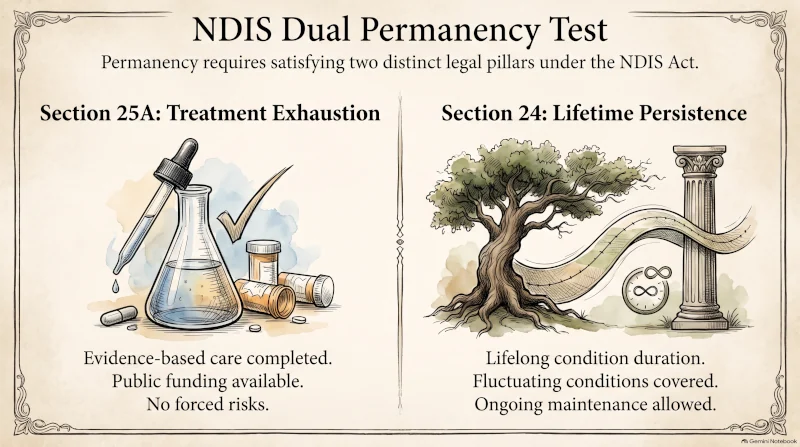
🏛️ The Dual Statutory Permanency Test
Pillar 1: Requires completing Treatment Exhaustion under Section 25A.
Pillar 2: Establishes Lifetime Persistence under Section 24.
Both pillars must be satisfied concurrently to establish statutory access and permanency under NDIS law.
What Qualifies as ‘Appropriate Treatment’ Under Section 25A?
Section 25A(1) establishes three cumulative legal criteria to define appropriate treatment:
- The treatment must be clinically evidence-based.
- The treatment must be capable of materially improving, reversing, or alleviating the impairment.
- The treatment must be regularly performed in Australia, with public funding or Medicare/PBS coverage serving as a key indicator.
For regional families across Chinchilla, Miles, and Tara, Section 25A(2) clarifies that geographic thin markets or personal financial constraints do not provide an exemption to appropriate treatment rules. That is, if a treatment that is considered appropriate is not available in your town or close to where you live, the NDIA planner will not take this into account. They will, however, take into account a formal medical exemption. Furthermore, the need for ongoing maintenance therapy to preserve daily functional capacity does not negate treatment exhaustion.
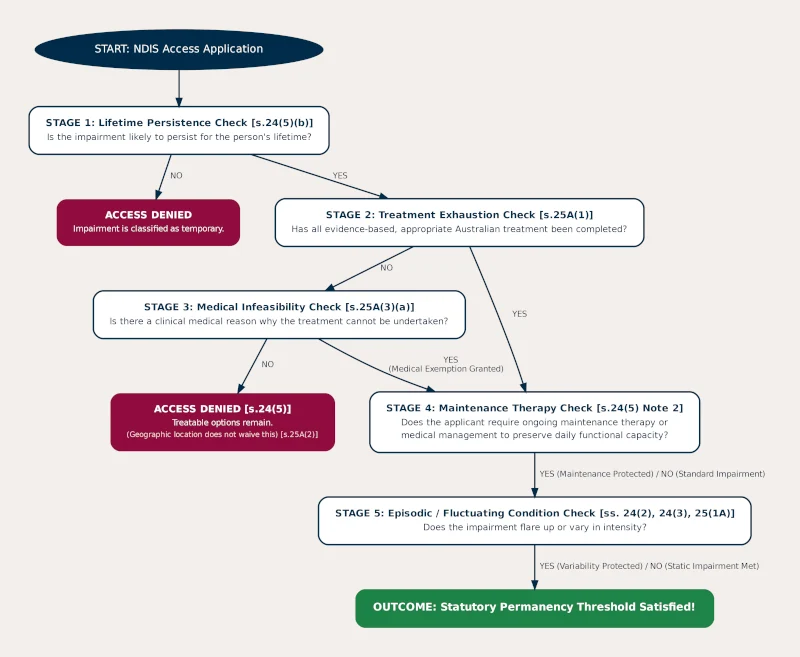
NDIS Access & Permanency Flowchart: Section 24 & Section 25A Evidence Pathways
📖 Click to read full plain-text breakdown of this flowchart
NDIS Access & Permanency Evidence Decision Tree:
- Initial Access Assessment (s.24 & s.25A): Requires proof that an impairment is attributable to an intellectual, cognitive, neurological, sensory, physical, or psychosocial condition, and that it is likely to be permanent.
- Section 25A Treatment Exhaustion Filter: Requires treating doctor documentation proving all clinically appropriate, evidence-based treatments available in Australia have been explored without curing the impairment.
- Medical Infeasibility Safeguard (s.25A(3)(a)): Explicitly exempts participants from undergoing high-risk, experimental, or medically contraindicated procedures.
Medical Infeasibility Exemptions and Participant Safeguards Under Section 25A
Section 25A(3)(a) provides vital legal safeguards, explicitly exempting participants from undergoing treatments that cannot be completed due to medical contraindications, clinical risks, or severe health complications. Department of Health guidelines confirm that participants are never expected to undertake unproven experimental trials, high-risk surgical procedures, or treatments impacting fertility.
In addition, Section 25A(1) Note 2 strictly excludes restrictive practices—including chemical, mechanical, physical, or environmental restraints—from treatment requirements. Statutory protections established in July 2026 confirm that once appropriate treatment is exhausted, no further exploratory or trial treatments can be demanded by the agency.
Evidence Preparation, Statutory Timelines, and Legal Review Pathways
Preparing clinical evidence requires separating Section 9B functional capacity baselines from Section 34 support needs. Section 9B evaluates functional capacity in relation to daily activities while considering ordinary assistance and assistive technology, operating independently of personal or environmental circumstances.
Understanding statutory review windows protects participant rights. An information request from a NDIA planner for more information about your disability under Section 26 that goes unaddressed for 90 days results in a deemed withdrawal. Conversely, if the NDIA fails to make a decision on an access request or request further information within 90 days (Read The NDIA’s Service Guarantees [Opens in a New Window], this constitutes a deemed refusal, which formally unlocks Section 100 internal review appeal rights.
📖 Click to read full plain-text breakdown of these treatment rules
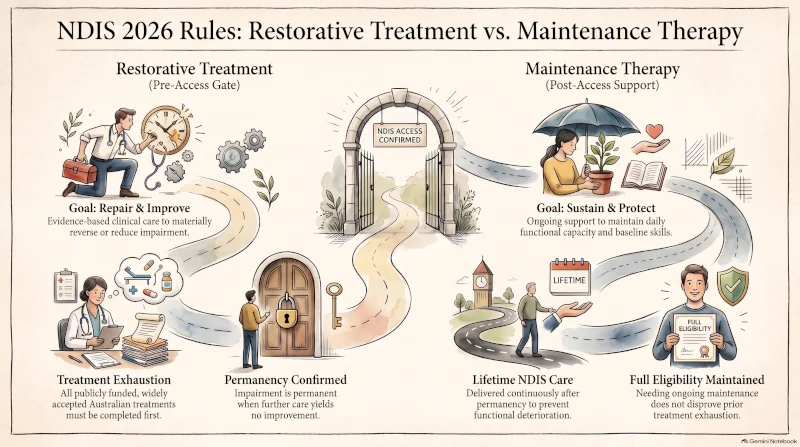
NDIS 2026 Rules: Restorative Treatment vs. Maintenance Therapy:
- Restorative Treatment (Pre-Access Gate — Section 25A)
- Goal: Repair & Improve: Evidence-based clinical care to materially reverse, alleviate, or reduce impairment.
- Treatment Exhaustion: All publicly funded, widely accepted Australian treatments must be completed first.
- Permanency Confirmed: Impairment is classified as permanent when further care yields no functional improvement.
- NDIS Access Gate: Official confirmation of NDIS scheme entry once permanency and Section 25A treatment exhaustion criteria are met.
- Maintenance Therapy (Post-Access Support — Section 24 & Section 34)
- Goal: Sustain & Protect: Ongoing support to maintain daily functional capacity and baseline skills.
- Lifetime NDIS Care: Delivered continuously after permanency to prevent functional deterioration.
- Full Eligibility Maintained: Under Section 24 Note 2, needing ongoing maintenance therapy does not disprove prior treatment exhaustion.
Measuring Success: Indicators That Matter
Participant Scenario: A participant’s plan is within the 90-day window of the plan end-date.
Intervention: Steady Guide audits the checkin logs, reviews the legislation and your functional needs, determines the evidence necessary for your plan review, identifies when it needs to be submitted, and identifies the appropriate expert required to produce your evidence.
Measurable Outcome: 100% of review submissions contain complete, treatment-exhausted clinical proof prior to submission. This does not mean that the NDIA planner will absolutely approve all requests, but it does significantly reduce the chances of NDIA declines.
To maintain high-touch advocacy, Principal Support Coordinator Jenny Mathers maintains a strict 20-client active caseload cap. Steady Guide measures success in a number of ways, including rate of checkins, self-advocacy coaching, decision-making support and goal progression.
Steady Guide refuses to use participants and their stories as a vehicle to promote itself. We let our performance speak for itself.
Words That Are Hard to Understand (Glossary)
Proving Permanency: Demonstrating with medical evidence that an impairment is lifelong and that all appropriate treatments (s.25A) have been completed.
Appropriate Treatment (s.25A): Clinically evidence-based treatment, regularly performed in Australia, that can reliably be expected to materially improve or alleviate an impairment.
Treatment Exhaustion: The point where all appropriate treatments have been undertaken without resolving the impairment.
Functional Capacity (s.9B): A person’s statutory ability to perform an activity without assistance, evaluated independently of personal or environmental context.
Deemed Withdrawal: The automatic closure of an access request if requested medical information is not provided within 90 days.
Deemed Refusal: The statutory outcome under Section 48 when the NDIA fails to decide on a plan reassessment within 90 days, opening appeal rights.
Bibliography & References
- National Disability Insurance Scheme Act 2013 (Compilation No. 27). Commonwealth of Australia. https://www.legislation.gov.au/C2013A00020/latest/text [External Link – Opens in new window]
- National Disability Insurance Scheme Amendment (Securing the NDIS for Future Generations) Bill 2026. Parliament of Australia. https://www.aph.gov.au/Parliamentary_Business/Bills_Legislation/Bills_Search_Results/Result?bId=r7487 [External Link – Opens in new window]
- Australian Government Department of Health, Disability and Ageing. (2026). About the changes to the NDIS: Defining ‘all appropriate treatment’. Commonwealth of Australia. https://www.health.gov.au/our-work/ndis-legislation-changes/amendments/ndis-amendment-securing-the-ndis-for-future-generations-bill-2026 [External Link – Opens in new window]
- NDIS Quality and Safeguards Commission. (2026). NDIS Practice Standards and Code of Conduct Rules. https://www.ndiscommission.gov.au/media-centre/parliament-passed-ndis-amendment-securing-ndis-future-generations-act-2026 [External Link – Opens in new window]
#SteadyGuide #NDISToowoomba #WesternDownsAdvocacy #NDISReform #PeoplePotentialPossibilities