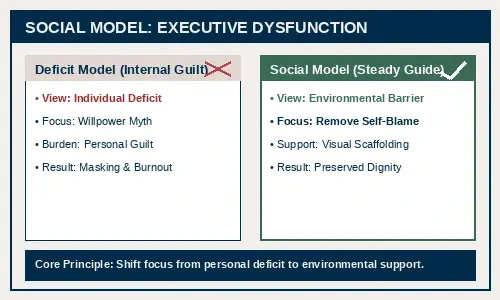
Building Capacity in Executive Dysfunction: A Person-Centred Approach
By Jenny Mathers | Principal Support Coordinator, Author & Carer Advocate | Published September 2026
At a Glance & Article Summary
Central Takeaway: Building true capacity in executive dysfunction requires moving away from deficit-based compliance and establishing low-demand environmental scaffolding, energy accounting, declarative language, and self-determined person-centred planning.
- Beyond Willpower: Executive dysfunction is a neurological gap between intention and execution, not a lack of effort or motivation.
- Energy Accounting: Tracking cognitive deposits and withdrawals prevents sensory overload, meltdowns, and long-term burnout.
- Declarative Language: Replacing imperative commands with curious observations lowers cognitive spikes and demand avoidance.
- 5D Decision Reset: Automating daily choices (Delete, Delegate, Default, Delay, Document) reduces decision fatigue.
- Person-Centred Frameworks: Utilising PATH and MAPS tools aligns NDIS capacity building with genuine self-determination.
It Is Not Your Fault: Re-framing Routine Management
Living with executive dysfunction—or caring for someone who does—often feels like navigating a day full of invisible hurdles. Simple daily tasks like meal preparation, managing schedules, or initiating a routine can drain cognitive energy long before the afternoon arrives. When internal executive control networks are overloaded by stress or fatigue, pushing harder is not the answer; building low-demand, supportive systems is.
At Steady Guide, we view routine management through the lens of human dignity, self-determination, and active recovery. We do not focus on “fixing” a person or enforcing compliance. Instead, we design environments where neurodivergent individuals and carers can thrive without carrying an unbearable administrative burden.
🌱 The “People, Potential, Possibilities” Lens
- PEOPLE FIRST: Prioritising human dignity, lived experience, and trauma-informed care over bureaucratic quotas and algorithmic scoring.
- NURTURING POTENTIAL: Refusing to define individuals by “deficit models” or forced “worst-day performances” during NDIS plan reviews.
- CREATING POSSIBILITIES: Building practical advocacy tools to defend independence, protect informal carers, and navigate regional thin markets across Toowoomba and the Western Downs.
💡 Jenny’s Practice Note: Executive dysfunction is not laziness or a lack of character. It is a neurological difference in how the brain manages task initiation, working memory, and energy. When we change the environment instead of demanding compliance, capacity grows naturally.
1. Beyond Willpower: The Neurobiology of Capacity
Executive functioning acts as the brain’s management system, governing task initiation, working memory, organisation, and emotional regulation. For Autistic individuals, ADHDers, and people living with psychosocial conditions, executive dysfunction represents a genuine neurological gap between intention and execution.
An individual may deeply want to complete a task, understand every step required, and fully recognise its importance—yet remain completely unable to initiate action due to cognitive overload or executive paralysis. Demanding higher willpower in these moments is as ineffective as asking a person with a broken leg to run faster.
🔗 For practical activities designed to enhance executive function across various developmental stages, explore the Harvard Center on the Developing Child Executive Function Guide [External Link – Opens in new window].
2. Energy Accounting: Managing the Cognitive Bank Account
Energy accounting treats personal cognitive energy like a financial bank account. Every sensory trigger, social cue interpretation, unexpected schedule shift, or forced compliance task acts as an energy withdrawal. Conversely, stimming, engaging with special interests, quiet rest, and sensory-friendly spaces act as vital energy deposits.
When energy withdrawals consistently exceed deposits, individuals experience severe cognitive overdrafts leading to meltdowns, shutdowns, or long-term autistic burnout. By tracking daily energy transactions, participants and carers can schedule intentional deposits before critical depletion occurs.
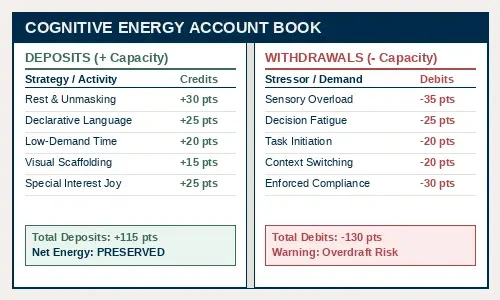
📊 Energy Accounting Model: Balancing daily cognitive credits and debits to prevent emotional overdraft and burnout.
3. Apply the 5D Decision Reset
To reduce caregiver fatigue and participant cognitive load, we implement the 5D Decision Framework to streamline and automate daily routines:
- Delete: Remove non-essential social expectations, perfectionist standards, and trivial daily choices.
- Delegate: Assign specific, recurring tasks (such as pharmacy pickups or routine administration) to formal support networks or automated services.
- Default: Automate daily routines through standing meal plans, recurring calendar reminders, and predictable weekly structures.
- Delay: Postpone non-urgent decisions by establishing fixed future review dates rather than holding open choices in working memory.
- Document: Externalise memory by maintaining care binders, visual daily checklists, and accessible shared schedules.
4. Declarative Language: Replacing Directives with Curiosity
Imperative language consists of direct commands, questions, and demands (e.g., “Put your shoes on,” “What do you want for lunch?”). For individuals experiencing demand avoidance or high executive fatigue, imperative statements trigger an immediate spike in threat response and cognitive resistance.
Declarative language replaces demands with shared observations, reflections, and curious statements that invite problem-solving without imposing pressure:
| Imperative Command (High Demand) | Declarative Statement (Low Demand) |
|---|---|
| “Get your coat on now.” | “I notice it is cold outside today.” |
| “Clean up your desk.” | “I see your workspace has a lot of items on it.” |
| “What do you want to do first?” | “I wonder which option feels easiest to start with.” |
5. Person-Centred Planning: PATH & MAPS Frameworks
Effective capacity building must be anchored in authentic person-centred planning frameworks such as PATH (Planning Alternative Tomorrows with Hope) and MAPS (Making Action Plans).
Rather than starting with system constraints or NDIS budget line items, these visual planning tools begin with the participant’s core preferences, relationships, strengths, and long-term life vision. By mapping out a clear picture of a desirable future, support coordinators and families can construct incremental, low-demand steps that build functional independence over time.
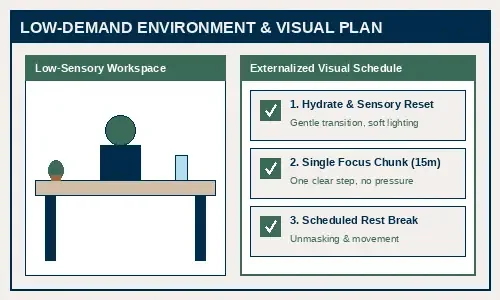
📊 The Calming Environment Model.
6. Bibliography & Academic References (56 Items)
Below is the exhaustive reference library supporting this practice guide, spanning clinical research, peer-reviewed studies, government audit reports, and monographs:
- 10 Strategies for Coping With Caregiver Stress
Publisher / Source: AgingCare.com | Type: Web Resource / Practice Guide
https://www.agingcare.com [Opens in new window] - Activities of Daily Living and Working Memory in Pediatric ADHD
Publisher / Source: PubMed Central (PMC) | Type: Peer-Reviewed Journal Article
https://pubmed.ncbi.nlm.nih.gov/33459154/ [Opens in new window] - An Introduction to Person Centred Planning – and Its Potential for Schools
Publisher / Source: All Means All! Inclusion Alliance | Type: Educational Policy Guide
https://allmeansall.org.au [Opens in new window] - Assessing Activity of Daily Living Task Performance Among Autistic Adults
Publisher / Source: PubMed Central (PMC) | Type: Peer-Reviewed Study
https://pubmed.ncbi.nlm.nih.gov/36601263/ [Opens in new window] - Body Doubling for Executive Dysfunction: The Expert Guide
Publisher / Source: Neurodiversity Resource Directory | Type: Clinical Guide
https://www.coachingexecutivefunction.com [Opens in new window] - Choice, Control and the NDIS
Publisher / Source: Melbourne Social Equity Institute | Type: Policy Research Paper
https://socialequity.unimelb.edu.au [Opens in new window] - Declarative Language Improves Problem Solving
Publisher / Source: Keywell Pediatric Research | Type: Article
https://www.keywell.com.au [Opens in new window] - Developing Routines for Autism
Publisher / Source: Magnet ABA | Type: Applied Behavioral Analysis Guide
https://www.magnetaba.com [Opens in new window] - Effectiveness of NDIA Management of Assistance with Daily Life Supports
Publisher / Source: Australian National Audit Office (ANAO) | Type: Government Performance Audit Report
https://www.anao.gov.au [Opens in new window] - Enhancing ADL Skill Acquisition in Children with ASD via Tablet Game
Publisher / Source: PubMed Central (PMC) | Type: Peer-Reviewed Study
https://www.ncbi.nlm.nih.gov/pmc/articles/PMC [Opens in new window] - Executive Function Fact Sheet and Activity Ideas
Publisher / Source: Perkins School for the Blind | Type: PDF Fact Sheet
https://www.perkins.org [Opens in new window] - Exploring the Impact of a Personalised Disability Reform on People
Publisher / Source: Disability & Society Journal | Type: Research Article
https://www.tandfonline.com [Opens in new window] - Helping Caregivers Manage Stress While Supporting Loved Ones
Publisher / Source: Heart to Heart (US Support Provider) | Type: Article
https://www.h2hhc.com [Opens in new window] - How Energy Accounting Can Improve Your Quality of Life
Publisher / Source: Thrive Autism Coaching | Type: Article
https://www.autismspectrum.org.au [Opens in new window] - How to Manage Your Energy Levels
Publisher / Source: Royal College of Occupational Therapists (RCOT) | Type: PDF Occupational Practice Guide
https://www.rcot.co.uk [Opens in new window] - Implementing Person-Centered Planning in STEM to Enhance Self-Determination
Publisher / Source: Rowan Digital Works / Rowan University | Type: PDF Academic Thesis
https://rdw.rowan.edu [Opens in new window] - INFORMATION SHEET – Positive Behaviour Support Planning
Publisher / Source: The Challenging Behaviour Foundation | Type: PDF Document
https://www.challengingbehaviour.org.uk/ [Opens in new window] - Longitudinal Planning: PATH Process
Publisher / Source: Inclusion Press & PATH Network | Type: Planning Monograph
https://autismplusil.org/ [Opens in new window] - Measuring Outcomes and Performance – NDIS Review
Publisher / Source: NDIS Independent Review Panel | Type: Government Policy Review
https://www.ndisreview.gov.au [Opens in new window] - More NDIS Participants and Families and Carers in Work, New Data Reveals (2024)
Publisher / Source: National Disability Insurance Agency (NDIA) | Type: Official Data Release
https://www.ndis.gov.au [Opens in new window] - NDIS Participants Choice and Control – Personal and Community Support
Publisher / Source: Australian Institute of Health and Welfare (AIHW) | Type: Government Statistical Report
https://www.aihw.gov.au [Opens in new window] - NDIS Participants, Families and Carers Report Significant Improvements
Publisher / Source: National Disability Insurance Agency (NDIA) | Type: Outcomes Evaluation Report 2023
https://www.ndis.gov.au [Opens in new window] - New Reports Show NDIS is Having Significant Positive Impact
Publisher / Source: Minister for the NDIS Press Office | Type: Ministerial Release & Data Summary
https://ndis.gov.au [Opens in new window] - Outcomes and Goals Framework
Publisher / Source: National Disability Insurance Scheme (NDIS) | Type: Official Data Research
https://dataresearch.ndis.gov.au/ [Opens in new window] - Parallel Play for Adults: Alone Together, Explained
Publisher / Source: NeuroDiversion | Type: Neurodiversity Article
https://www.neurodiversion.com [Opens in new window] - Person Centred Planning Using the PATH Tool – Support Plans
Publisher / Source: Kirklees Council | Type: Implementation Manual
https://www.kirkleeslocaloffer.org.uk/ [Opens in new window] - Person-Centered Planning – The Self-Determination Interchange
Publisher / Source: Disability Voices United | Type: Advocacy Resource
https://disabilityvoicesunited.org [Opens in new window] - Positive Coping: Mastering Demands and Searching for Meaning
Publisher / Source: Freie Universität Berlin | Type: PDF Research Monograph
https://www.fu-berlin.de [Opens in new window] - Practical Strategies to Support Executive Functioning at Home
Publisher / Source: NeurAbilities Healthcare | Type: Article
https://www.neurabilities.com [Opens in new window] - Practices, Promises, and Provisos Abstract Person-Centered Planning
Publisher / Source: The Journal for Vocational Special Needs Education | Type: PDF Research Article
https://eric.ed.gov [Opens in new window] - Previous Participant Outcomes Reports
Publisher / Source: National Disability Insurance Scheme (NDIS) | Type: Historical Archive
https://www.ndis.gov.au [Opens in new window] - Proactive Coping Behavior in Sample of University Students in Helping Professions
Publisher / Source: Journal of Applied Psychology | Type: PDF Empirical Study
https://www.psychologyjournal.org [Opens in new window] - Proactive Coping Strategies for Caregivers
Publisher / Source: Alzheimer’s and Dementia Association Blog | Type: Caregiver Practice Brief
https://www.alz.org [Opens in new window] - Proactive vs. Reactive Behavior Supports in ID/DD
Publisher / Source: Among Friends Disability Services | Type: Whitepaper
https://www.amongfriends.org [Opens in new window] - Reactive, Anticipatory, Preventive, and Proactive Coping Framework
Publisher / Source: ResearchGate / Schwarzer & Taubert | Type: Peer-Reviewed Article
https://www.researchgate.net [Opens in new window] - Reducing Decision Fatigue for Caregivers
Publisher / Source: Careforth Healthcare | Type: Care Management Article
https://www.careforth.com [Opens in new window] - Self-Determination Theory Of Motivation
Publisher / Source: Simply Psychology | Type: Educational Reference
https://www.urmc.rochester.edu/ [Opens in new window] - The 4 Stages of Caregiver Burnout: Recovery Roadmap & Expert Insights (2026)
Publisher / Source: Caregiver Burnout Institute | Type: Clinical Roadmap
https://www.caregiverburnout.org [Opens in new window] - The Key Principles of Person-Centred Planning
Publisher / Source: In Control Organization | Type: PDF Values Statement
https://www.in-control.org.uk [Opens in new window] - The Mental Load of Caregiving: Recognising Burnout and Finding Support
Publisher / Source: Dr. Quintal & Associates Counseling Center | Type: Practice Note
https://www.drquintal.com [Opens in new window] - The P.A.T.H.™ Process – North Star Facilitators
Publisher / Source: North Star Facilitators | Type: Facilitator Guide
https://www.northstarfacilitators.com [Opens in new window] - The Proactive Coping Inventory
Publisher / Source: Freie Universität Berlin | Type: Academic Resource
https://www.user.fu-berlin.de/~health [Opens in new window] - The Impact of Induced Stress on Reactive and Proactive Control in Depression
Publisher / Source: PubMed Central (PMC) | Type: Neuroimaging / Neuroscience Study
https://www.ncbi.nlm.nih.gov/pmc/articles/PMC [Opens in new window] - The Potential for Person-Centred Planning to Support Community Inclusion
Publisher / Source: Journal of Intellectual & Developmental Disability | Type: Peer-Reviewed Study
https://www.tandfonline.com [Opens in new window] - Self-Determination Theory
Publisher / Source: Center for Self-Determination Theory | Type: Academic Overview
https://www.selfdeterminationtheory.org [Opens in new window] - Understanding and Managing Caregiver Stress Syndrome
Publisher / Source: Caregiver Action Network | Type: Article
https://www.caregiveraction.org/ [Opens in new window] - What is Behavioural Scaffolding for Adults with ADHD?
Publisher / Source: VOX Mental Health | Type: Article
https://www.voxmentalhealth.com [Opens in new window]