Securing The Future NDIS Reform: Previewing the Book
By Jenny Mathers | Principal Support Coordinator, Author & Carer Advocate | 18 Published September 2026 | Estimated Read Time: 6 Minutes
AT A GLANCE: EXECUTIVE SUMMARY & STRATEGIC TOUCHPOINTS
- From Reactionary Anger to Strategic Clarity: Equipping regional Queensland families with statutory knowledge, clinical rigour, and self-advocacy mechanisms to navigate plan reviews with confidence.
- Mastering the Legislative Shift: Understanding how the passed 2024 Bill (Section 10 Support Lists, Section 33 budget components) and the 2026 Amendment Bill (ADM safeguards, unscheduled reassessment rules) reshape participant rights.
- Addressing Thin-Market Realities: Navigating regional service gaps across Toowoomba, Chinchilla, Miles, and Tara while preparing for multi-year transitions (Thriving Kids 2026 and 2028 Lead Provider Commissioned Panels).
- The ‘People, Potential, Possibilities’ Framework: Anchoring advocacy in human dignity, functional outcomes, and measurable capacity building rather than deficit-based rhetoric.
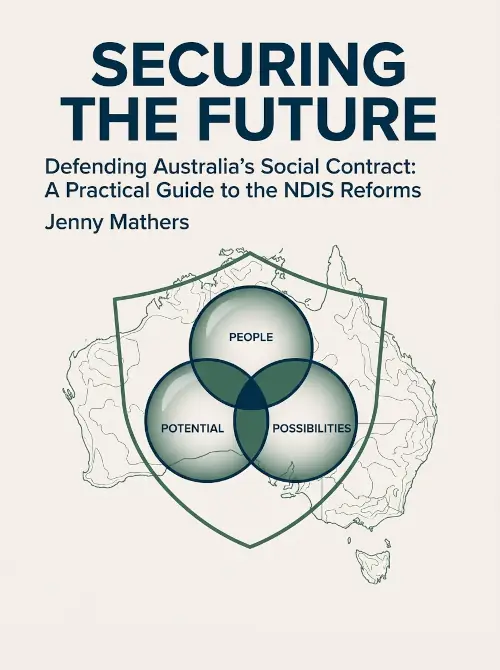
📷 Official Book Launch Date: 14 November 2026. For ongoing updates, statutory analyses, and advocacy templates, consider joining the Steady Steps community newsletter or like our Facebook page. [Opens in New Window]
1. The View from the Kitchen Table: A Regional Reality
It is a moment I regularly witness in my daily work as a Support Coordinator across Toowoomba, Chinchilla, Miles, and Tara: a mother sits at her kitchen table holding a comprehensive Occupational Therapy assessment detailing why a basic bathroom modification or safety railing is essential to prevent her adult son from falling. When the planner or local area coordinator calls to decline the request, her initial reaction is shock, followed swiftly by exhaustion and anxiety.
She did not ask for a luxury upgrade; she requested the fundamental ability for her child to wash safely and maintain personal dignity. In regional Queensland, these administrative hurdles are compounded by geographical realities. Where metropolitan centers benefit from dense provider markets, regional families face extended specialist waitlists, higher clinical travel costs, and severe thin-market deficits.
When legislative changes alter eligibility or budget rules, regional participants feel the impact first. Understanding the underlying statutory mechanics is not an academic exercise—it is the essential tool regional families need to protect their supports and ensure their voices are heard.
💡 Jenny’s Advocacy Note: Reactionary anger rarely changes administrative decisions under NDIS law. True self-advocacy requires statutory clarity, objective evidence, and understanding your rights under Section 34.
2. Navigating the 2024–2026 Legislative Upheaval
The legislative landscape governing the NDIS has undergone two major statutory shifts that every participant and advocate must understand:
📜 The 2024 Passed Act (Getting the NDIS Back on Track No. 1 Act 2024 [Opens in New Window])
Enacted on 3 October 2024, this legislation established the official Section 10 NDIS Support Lists (defining fundable ‘In’ supports and non-fundable ‘Out’ items) and introduced Section 33 total funding components and structured funding periods into participant plans.
🏛️ The 2026 Amendment Bill (Securing the NDIS for Future Generations Bill 2026 [Opens in New Window])
Introduced on 14 May 2026 and passed in August 2026, this reform package introduces Automated Decision-Making (ADM) transparency safeguards (Sections 59B–59E), limits unscheduled plan reassessments (Section 48A), and strengthens pricing oversight.
When dense legal changes are introduced quickly, anxiety naturally spreads across the disability community. However, reactionary anger rarely changes administrative decisions. Systemic advocacy requires strategic clarity. By understanding statutory definitions, evidence standards, and review rights, participants can transform feelings of powerlessness into effective, evidence-based self-advocacy.
3. Beyond the Clinical Vacuum: Functional Capacity & Evidence Alignment
A core focus of Securing the Future is demystifying how functional capacity and plan evidence are evaluated under the reformed NDIS Act:
Section 9B & Functional Capacity Frameworks: Section 9B establishes statutory rules for evaluating functional impairment. While initial proposals sought to assess functional capacity in a ‘context-free’ environment, statutory safeguards confirm that standard assistive technology and adaptive equipment are taken into account during assessments, while Section 34 evaluates overall support needs within a participant’s broader environmental and social context.

📍 Regional Queensland Catchment Map: Supporting participants and families in Toowoomba, Chinchilla, Miles, and Tara.
4. Chapter Roadmap: Architectural Guide to ‘Securing the Future’
The forthcoming book is structured into eight core chapters and a practical appendix suite, providing a comprehensive roadmap for participants, families, and practitioners:
| Chapter & Title | Core Focus & Statutory Integrations |
|---|---|
| Chapter 1: The Deficit Trap of Eligibility | Deconstructing the administrative trauma of proving one’s ‘worst self’ during intake; navigating deficit-based planning without sacrificing human dignity. |
| Chapter 2: Stability and Hope: New Definitions of Permanence | Navigating Section 24 eligibility, Section 25A clinical safeguards (Public Funding Rule & Restrictive Practices Ban), and documenting regional service deficits. |
| Chapter 3: Beyond the Clinical Vacuum | Contrasting Section 9B functional capacity rules with strengths-based biopsychosocial assessment tools (I-CAN v6) and ICF frameworks. |
| Chapter 4: Defining ‘Reasonable and Necessary’ | Understanding Section 34 statutory criteria, the 8% annual growth target, budget financial sustainability rules, and leveraging outcome data. |
| Chapter 5: Overcoming the ‘Robodebt Shadow’ | Navigating Section 10 Support Lists, the $500 debt recovery threshold, replacement support substitution rules, and Contextual Purpose Statements. |
| Chapter 6: Families, Carers, and Support Boundaries | Evaluating Section 34 parental responsibility presumptions, carer burnout risks, and navigating the 1 October 2026 ‘Thriving Kids’ early childhood reset. |
| Chapter 7: Regional Frontiers & Offline Workflows | Managing thin markets in Chinchilla, Miles, and Tara; leveraging offline coordination workflows, collaborative travel blocks, and local networks. |
| Chapter 8 & Appendices: Autonomy & Systemic Advocacy | Preparing for 2028 Lead Provider Commissioned Panels, Automated Decision-Making (ADM) SOP safeguards under Section 59E, and the Section 100 Evidence Checklist. |