Building Capacity in Executive Dysfunction – Easy Read Guide
Written by Jenny Mathers | Principal Support Coordinator and Carer Advocate
What is in this guide
1. Executive dysfunction is not your fault
Your brain manages tasks. Executive functioning is how your brain plans, remembers, starts, and finishes everyday activities.
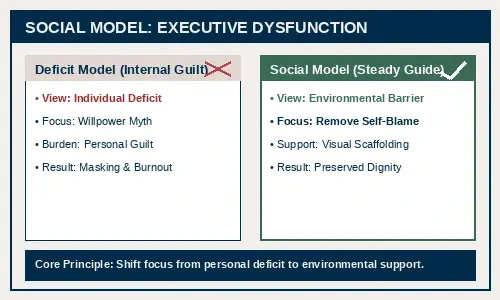
Executive dysfunction is a barrier. When your brain gets overloaded, starting a simple task can feel like moving a heavy wall.
It is not laziness. Executive dysfunction is a real brain difference. It is not a lack of effort or willpower.
The environment matters. Noise, clutter, complex rules, and high stress make executive dysfunction harder.
2. What NDIS capacity building really means
Building capacity is not forcing change. True support does not mean trying to hide your neurodivergent traits.
Good support builds scaffolding. We set up tools, visual prompts, and supportive spaces that make life easier.
Dignity of risk is important. Under NDIS Practice Standards, you have the right to make choices and try new things.
3. Declarative language: Asking with curiosity
Direct commands cause stress. Saying “Clean your room right now” can trigger anxiety and shut down action.
Declarative language shares facts. Saying “I notice there are clothes on the floor” invites thinking without pressure.
Comparing Words We Use
| High Demand (Avoid) | Declarative Fact (Use This) |
|---|---|
| “Do your dishes now!” | “The sink has plates in it.” |
| “Put your shoes on!” | “We leave in 10 minutes.” |
| “Stop looking at your phone!” | “I wonder what our next step is.” |
4. Energy accounting and the 5D Decision Reset
Brain energy is like a battery. Every activity uses up energy. Quiet rest recharges your energy bank.
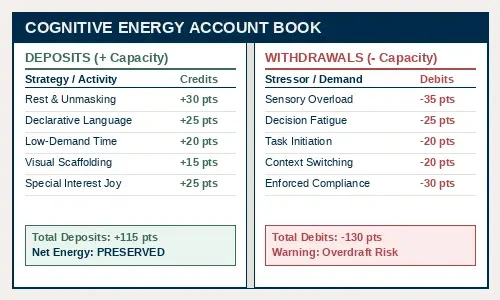
The 5D Decision Reset helps when stuck. Use these 5 simple steps when decisions feel overwhelming:
- ❌ 1. Delete: Cross off tasks that are not essential today.
- 🤝 2. Delegate: Ask a support worker or carer to help.
- ⚙️ 3. Default: Set up automated habits so you do not have to choose every time.
- ⏳ 4. Delay: Put off non-urgent choices until tomorrow.
- 📝 5. Document: Write things down or use visual lists to free up brain space.
5. Person-centred planning tools (PATH & MAPS)
Visual maps make goals clearer. Tools like PATH and MAPS use pictures, posters, and simple steps to plan your future.
You are the leader of your plan. Person-centred planning focuses on your strengths, choices, and personal goals.
6. Read the scientific references
Grounded in 56 Academic & Clinical Studies
This guide is based on neuroscience research, NDIS Practice Standards, and person-centred psychology.
👉 Read all 47 references in our Standard Article Bibliography
7. Words that are hard to understand
- Executive Dysfunction
- When your brain finds it hard to plan, start, remember, or finish tasks due to energy strain or stress.
- Capacity Building
- Setting up tools, routines, and support systems that help you live independently and reach your goals.
- Declarative Language
- Sharing observations or facts without giving direct orders or demands.
- Energy Accounting
- Balancing how much brain energy you spend during the day with quiet rest to prevent burnout.
- Person-Centred Planning
- Making plans that focus on your individual strengths, preferences, and choices.
- Dignity of Risk
- Your right to make your own choices, try new activities, and learn from experience.
1 thought on “Easy Read Building Capacity in Executive Dysfunction”
Comments are closed.