
📖 Prefer Easy Read? We have a simple, accessible version of this article with picture cards, short sentences, and a plain-English glossary. Switch to the Accessible Easy Read Edition of this article.
Local NDIS Advocacy Regional Queensland: Why Place-Based Support Matters
By Jenny Mathers | Principal Support Coordinator, Author & Carer Advocate | Published 15 September 2026
At a Glance & Quick Navigation
Central Takeaway: In regional Queensland’s thin markets, place-based local advocacy protects your NDIS plan from top-down bureaucracy and prevents uncoordinated travel fees from swallowing your support budget.
- 1. The Tyranny of Distance: Minimising Travel Costs in the Western Downs: Stopping plan “leakage” by sharing clinical travel overheads across regional hubs.
- 2. The Human Firewall: Why We Reject AI-Generated Reports: Ensuring clinical reports are written by human hearts and minds, protecting participant privacy.
- 3. Cultural Openness: Respecting the Rhythms of Regional QLD: Adapting NDIS advocacy to First Nations, farming, and mining communities.
- 4. Pro-Tip: Securing Travel Funding (The MMM Framework): Using your Modified Monash Model classification to claim essential travel funding.
- 5. Designing Your Social Advocacy Network (SNA): Turning isolated regional families into a collective engine for systemic change.
- 6. The Steady Guide Commitment: Dedicated 1:1 support coordination backed by a capped caseload of 20 participants.
1. The Tyranny of Distance: Minimising Travel Costs in the Western Downs
For families across Toowoomba, Tara, Chinchilla, and Miles, geography is often weaponised by bureaucratic systems. In what policy-makers politely label “thin markets”—but what we on the ground recognise as severely under-resourced communities—the greatest threat to your NDIS budget isn’t a lack of personal need; it is predatory or uncoordinated travel billing.
What happens when you finally secure a specialist, only to be charged for a 400km round trip for a single hour of therapy? Or when a distant provider stops showing up because regional travel feels “too hard,” while still drawing down monthly management fees? This is not merely a logistical hurdle; it is commercial ableism that drains vital participant funding.
Regional support coordination must be place-based and advocacy-focused to ensure your funding reaches your kitchen table rather than disappearing into petrol tanks.
| Standard Metro Provider Approach | Steady Guide Local Advocacy Approach |
|---|---|
| Uncoordinated Visits: Multiple clinicians drive to the same regional town on separate days, billing full travel fees to each participant’s plan. | Coordinated Travel Blocks: Scheduling appointments across a regional hub on designated travel days to split travel overheads across multiple plans. |
| Passive Plan Leakage: A single regional family absorbs the entire financial burden of long-distance specialist travel. | Shared Clinical Overheads: Leveraging local community networks to align clinician visits with regional community rhythms. |
| Reactive Crisis Billing: Providers visit only during acute emergencies, leading to unpredictable, expensive travel invoices. | Strategic Hub-and-Spoke Outlets: Building sustainable regional service channels that ensure timely care without metropolitan price tags. |
💡 Jenny’s Advocacy Tip: Managing travel costs is vital, but we must also guard against administrative overreach that attempts to replace human clinical insight with automated software text.
2. The Human Firewall: Why We Reject AI-Generated Reports
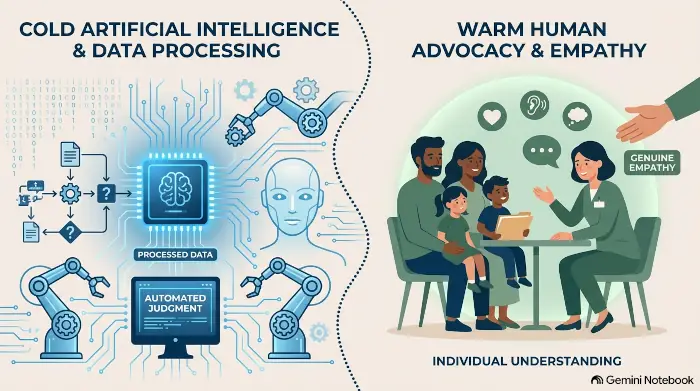
As a fierce advocate, I view the growing industry trend toward automated, AI-generated clinical reporting as a compromise of human dignity. Reducing a complex human life—rich with potential, family history, and personal strengths—to computer-generated text is fundamentally disrespectful.
It is also dangerous. The more that external providers input participant circumstances—even de-identified details—into public AI tools, the greater the risk that automated models can re-identify individuals over time. When successive personal details are used in prompts across multiple sessions, participant privacy is gradually eroded. Read the Australian Privacy Principles (page 13, B.64). [Opens in a new window.]
What happens if an algorithm connects data points and misidentifies a young participant? What if software “hallucinates” a non-existent diagnosis that is inserted into a funding application? NDIS plans must be built on genuine human observation, not automated guesses.
Our 3 Ethical Boundaries of Technology:
- 1. Sensitive Data Protection: Your clinical history and personal story are never used as training fuel for external machines. If a provider uses software tools, ask them explicitly how your data is handled.
- 2. Clinical Integrity: Genuine progress requires a human professional who understands the daily reality of a carer and sees subtle developmental milestones. Algorithms cannot comprehend thin-market realities.
- 3. Human-Centric Value: We reject unvetted AI generation in favour of ethical administrative technology. We use tools to improve scheduling and directory accessibility, but every document written about your life comes from a human heart and mind.
3. Cultural Openness: Respecting the Rhythms of Regional QLD
Advocacy across Toowoomba and the Western Downs demands cultural humility. Bureaucratic systems must adapt to the community, not the other way around. We respect the distinct economic and social cycles that metropolitan planners frequently overlook:
First Nations Communities
We prioritise cultural safety and place-based connection. Effective advocacy involves collaborating with Elders and local leaders to ensure support respects Country and kinship, particularly where formal identification or Medicare cards are difficult to access.
Agricultural & Farming Families
Disability support needs do not pause during harvest. We adapt meeting schedules around seasonal demands and the physical isolation of life on the land.

Resource & Mining Communities
Shift work and roster schedules require flexible coordination that accommodates non-standard working hours without penalising families.
4. Pro-Tip: Securing Travel Funding (The MMM Framework)
Here is a practical self-advocacy strategy: NDIA planners rarely include essential travel funding automatically. They often default to metropolitan assumptions unless you explicitly present the evidence.
Checklist for Securing Travel Funding:
- Identify Your MMM Classification: Confirm your town’s Modified Monash Model rating (MMM4–MMM7). A higher number strengthens your formal argument for regional travel loadings.
- Document Local Provider Shortages: Keep a record of local specialists with closed waiting lists. Documented evidence of a thin market is your strongest advocacy lever.
- Reject Inadequate Telehealth Defaults: If you reside in an MMM6 or MMM7 zone, do not settle for distant video assessments when face-to-face evaluation is clinically required. Document why remote assessments fail to capture daily environmental obstacles.
5. Designing Your Social Advocacy Network (SNA)
Social Network Analysis (SNA) is simply a structured way of mapping out who in your local area truly supports your family. It transforms isolated households into a collective community force capable of overcoming regional service gaps. Read more about Social Network Analysis.[Opens in a new window]
Building Collective Regional Leverage:
- Local Carer Networks: Share real-time intelligence regarding which visiting therapists provide reliable care versus those offering uncoordinated visits.
- Community Leaders: Engage local school principals, GPs, and community health nurses who observe regional service gaps firsthand.
- Regional Health Hubs: Collaborate with local community centres to establish shared consultation spaces.
The primary advantage is clear: a single family’s concern is treated as an isolated case, but a community’s shared evidence becomes a compelling mandate for systemic improvement.
6. The Steady Guide Commitment
Steady Guide was created by a carer, for participants and families across regional Queensland. I care for two family members living with disability—this lived experience shapes everything we do.
To ensure every participant receives high-touch, expert-led coordination, I strictly limit my active caseload to a maximum of 20 participants. After over 40 years of personal carer experience and more than 5 years navigating NDIA and Local Area Coordination (LAC) systems, I know that effective advocacy requires dedicated time and energy.
You are never a line item on a spreadsheet at Steady Guide. You receive direct expertise, empathy, and practical guidance every step of the way.
#SteadyGuide #NDISToowoomba #WesternDownsAdvocacy #NDISReform #PeoplePotentialPossibilities